

Most travellers meet Sri Lankan Ayurveda for the first time in a dimly lit treatment room. Warm oil, a steady hand, the scent of coconut and herbs, a therapist working in silence. It is a genuine experience, and for many visitors it is the most restful hour of their journey. But it is also the last chapter of a very long story, and the least interesting part of it.
Behind the oil massages and herbal baths sits something more substantial: a body of medical knowledge that has been practised on this island for centuries, argued over, written down, taught, regulated by statute, and eventually built into a national university. Sri Lanka is one of relatively few countries where traditional medicine is not merely tolerated alongside biomedicine but funded, licensed and taught to degree level by the state.
That raises a question worth carrying with you on a trip here. Village healing knowledge, once passed from a physician to their own children, is now examined in lecture halls and teaching hospitals. How did that happen? A large part of the answer runs through one man, one rural plot of land in Yakkala, and one date: 19 July 1929.
Sri Lanka's Ayurveda experience is not simply about massages and wellness resorts. It is connected to a much deeper heritage of indigenous medical knowledge, education, healing traditions and cultural identity.
The Roots of Healing in Sri Lanka
Sri Lanka's written record of organised healthcare is unusually old. The Mahavamsa, the Pali chronicle compiled around the sixth century CE, reports that King Pandukabhaya, traditionally placed in the fourth century BCE, had lying-in homes and treatment halls built in various parts of the country. Chronicles are not neutral documents and were written centuries after the events they describe, so historians treat such passages as evidence of how healthcare was understood and valued, rather than as a verbatim record.
The archaeological evidence is firmer. At Mihintale, near Anuradhapura, the ruins of a monastic hospital complex attributed to the reign of King Sena II (853–887 CE) survive today. Excavations there revealed a layout of around thirty-one rooms arranged on a raised platform, a stone medicinal immersion trough, and surgical instruments. The site is frequently described as one of the oldest hospitals in the world for which physical archaeological evidence exists, a claim advanced by the medical historian Heinz E. Müller-Dietz and noted by UNESCO's Silk Roads Programme. If you visit Anuradhapura, the ruins are a short drive away and rarely crowded.
Three traditions, often confused
International visitors tend to use "Ayurveda" as a catch-all for anything traditional and herbal. In Sri Lanka the distinctions are real, and they matter legally as well as culturally. The country's regulatory framework recognises several separate systems:
- Ayurveda — the classical system rooted in Sanskrit texts such as the Charaka Samhita and Sushruta Samhita, shared across South Asia, organised around concepts including the three doshas.
- Siddha — a tradition with its own textual lineage in Tamil, historically strongest in South India and in Sri Lanka's Tamil-speaking regions, with distinctive pharmacology including mineral and metallic preparations.
- Deshiya Chikitsa — often translated as indigenous or native medicine, and sometimes called Hela Wedakama. This is the island's own accumulated body of practice, including bone-setting, snakebite treatment, eye treatment and herbal knowledge, much of it transmitted within families rather than through classical texts.
- Unani — the Graeco-Arabic tradition, present in Sri Lanka through Muslim communities and also formally recognised.
These traditions borrowed from each other over centuries and today are grouped administratively under the heading of indigenous medicine. But they are not interchangeable, and it is inaccurate to describe every traditional Sri Lankan healing practice as Ayurveda. The distinction is preserved in law: under the Ayurveda Act No. 31 of 1961, the Ayurvedic Medical Council registers practitioners separately across Ayurveda, Siddha, Unani and traditional medicine.
How the Knowledge Was Passed Down
For most of Sri Lankan history there was no such thing as enrolling to study medicine. Knowledge moved through households. A veda mahattaya, a traditional physician, taught their children and sometimes a small number of apprentices who lived and worked alongside them, often for years.
The training was practical before it was theoretical. A student learned to recognise plants in the field, at the right season and the right stage of growth. They learned to prepare decoctions, medicated oils and pastes, which meant learning proportions, timings and the behaviour of ingredients under heat. They sat in on consultations. They watched how an experienced physician read a patient's pulse, complexion, tongue, appetite and sleep, and how those observations were turned into a treatment plan. Written material existed, frequently on ola palm-leaf manuscripts, but it functioned as an aid to memory for someone already being taught in person, not as a substitute for a teacher.
This system produced genuine expertise, and some families held specialised reputations across generations. It also had structural weaknesses. Knowledge was concentrated in individual lineages and could be lost outright when a line ended or when a manuscript decayed. Standards varied from physician to physician with no external benchmark. Specialised techniques were sometimes guarded as family property rather than shared. And through the nineteenth and early twentieth centuries, under British colonial administration, the state's resources and prestige flowed towards Western medicine, leaving indigenous practice without institutional support or a recognised route to qualification.
By the early twentieth century a number of Sri Lankan physicians and reformers had reached the same conclusion: if this knowledge was to survive and develop rather than slowly erode, it needed schools, examinations, a documented curriculum and a public standing of its own.
Pandith G. P. Wickramarachchi
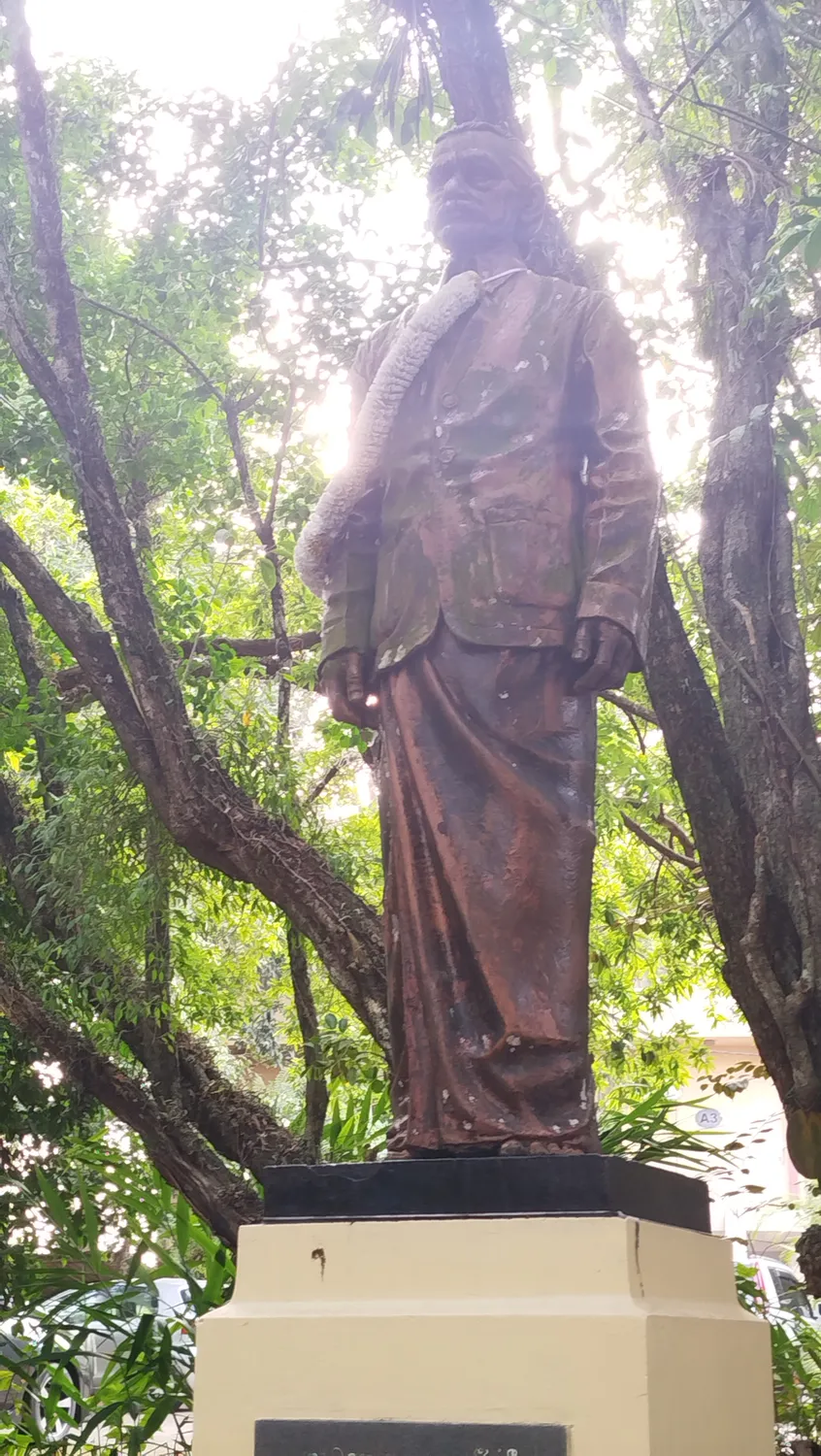
Gabriel Perera Wickramarachchi — known by the honorific Ayurveda Chakravarthi Pandith — was born in September 1889 at Nadungamuwa in the Gampaha district, in the belt of villages inland from Colombo where paddy land gives way to rubber and jak trees. He died on 29 March 1975.
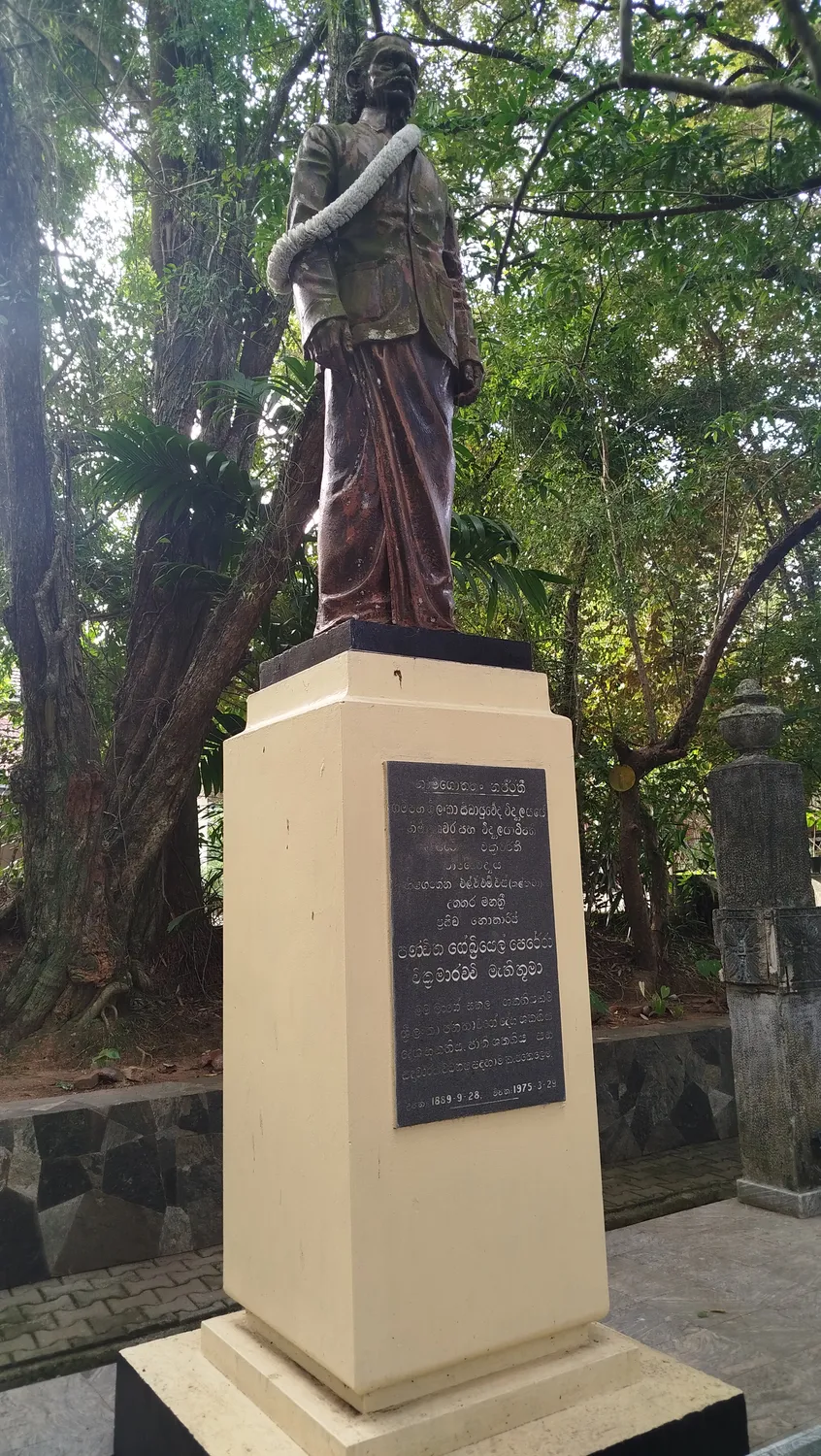
A note on his date of birth. Sources disagree. The official history published on the university's website gives 20 September 1889. The inscription on his memorial statue at the Yakkala campus, photographed for this article, reads 1889-9-28. Published biographical accounts also give 28 September. We have not found an explanation for the discrepancy, and rather than silently choose one, we note that the monument on the founder's own campus and the biographical record agree on 28 September, while the university's web page gives 20 September.
In 1917 he travelled to Calcutta to study at the Ashtanga Ayurveda Vidyalaya. The choice is telling. That institution had been founded only the previous year, in 1916, by Kaviraj Jamini Bhushana Roy, one of the most prominent Ayurvedic scholars in India and a central figure in the movement to revive and systematise Ayurvedic education under colonial rule. Wickramarachchi studied directly under Roy and qualified L.A.M.S., with the title Bhishagratna — the memorial inscription dates the qualification to 1920.
What he encountered in Calcutta was not simply more Ayurvedic knowledge. It was a working demonstration that Ayurveda could be taught the way a modern profession is taught: a fixed curriculum, sequenced subjects, formal examinations, a graduating class. He returned to Ceylon having seen the model he would spend the rest of his career building at home.
Wickramarachchi was not solely a physician. The memorial inscription lists him as a senator and a public notary alongside his medical titles, and biographical accounts add author and linguist; he was nominated to the Senate of Ceylon in 1957, which gave the cause of indigenous medicine a voice in the legislature at a moment when its future status was being decided.
It is worth resisting the temptation to inflate him. Sri Lanka's indigenous medical traditions were sustained by thousands of practitioners whose names were never recorded, and the movement to formalise Ayurvedic education had several contributors. Wickramarachchi's specific and verifiable contribution is narrower and, arguably, more impressive for being so concrete: he built an institution, kept it running at his own expense, and it outlasted him by half a century.
1929: A College on His Own Land
On 19 July 1929, Wickramarachchi founded a college for the teaching of Siddhayurveda and indigenous medicine on land he personally owned at Yakkala, near Gampaha. The institution's official history records the name as the Gampaha Sri Lanka Siddhayurveda Vidyalaya, and the Sinhala inscription on his memorial statue gives the same name. It appears in several variant forms elsewhere — Gampaha Siddhayurveda Vidyalaya, and in English-language accounts as a medical college — which is common for institutions of this period and region.
Accounts indicate it opened with around twenty students, and — this is the detail that says most about his intentions — that he charged them no fees, maintaining the school out of his own resources. A private individual in colonial Ceylon was subsidising the training of indigenous physicians because no one else would.
Three years later, in 1932, he added the infrastructure that turned a school into a functioning medical institution: clinical treatment facilities and a pharmaceutical operation for manufacturing medicines, recorded in the university's history as the Dhathovya Cikithsagara and the Siddhayurveda Rasayanoushada Samagama. Students could now see patients under supervision and learn compounding at scale. Teaching, treatment and medicine production sat on one site.
The significance of 1929 is not that formal Ayurvedic education began in Sri Lanka that day. It is that a durable institution was created — one with a curriculum, a location, a governing structure and, before long, its own hospital and dispensary. Family lineages end. Institutions can be handed on. Every subsequent step in this story depended on that one.
The Memorial Building at Yakkala
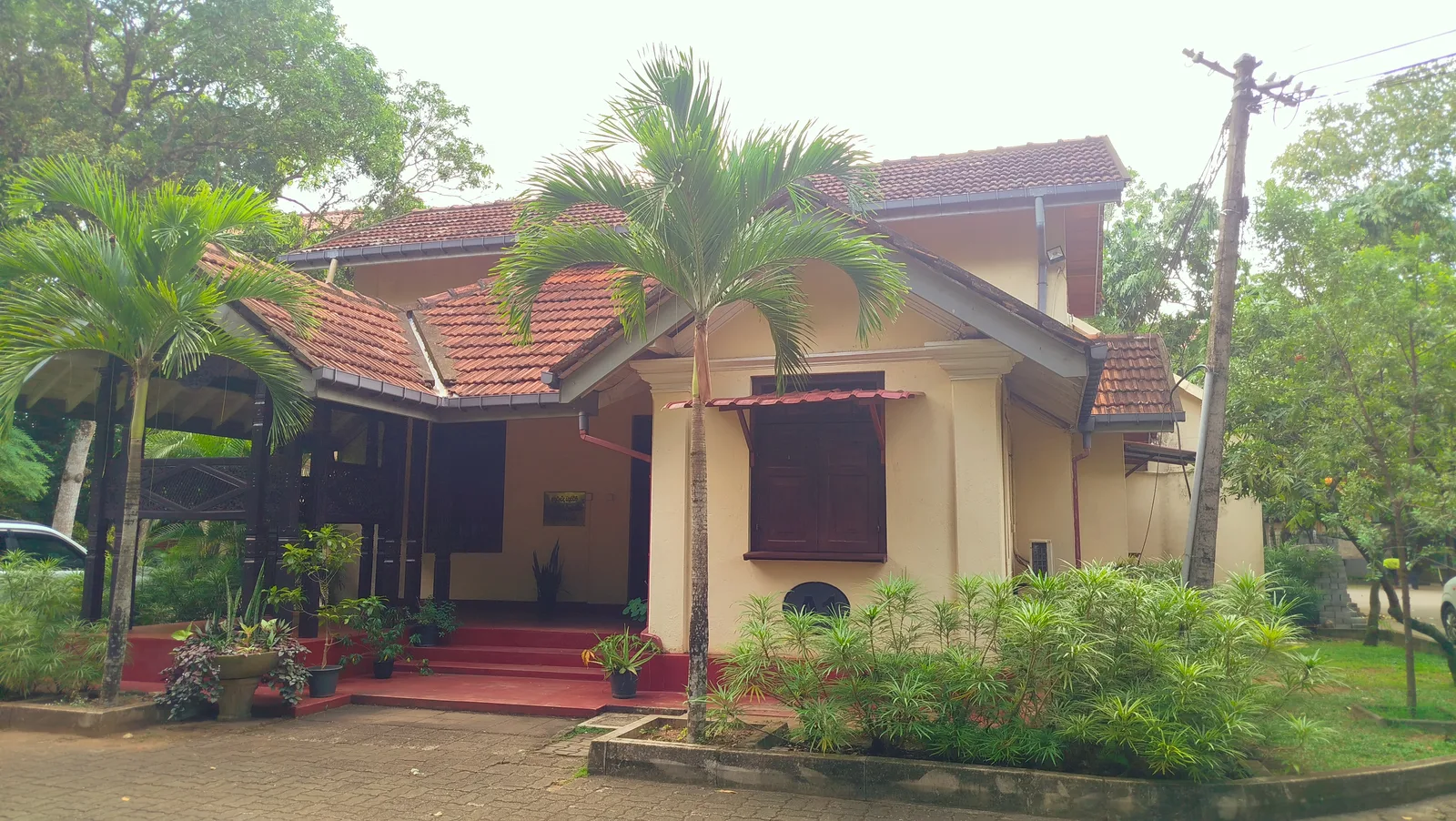
On the campus today stands a building that carries the founder's name. The brass plate beside its door reads, in Sinhala, Ayurveda Chakravarthi Pandith G. P. Wickramarachchi Anusmarana Mandiraya — Memorial Building. It is a modest structure by the standards of university architecture: a tiled roof, a deep verandah on carved black timber columns with pierced fretwork panels, a red polished floor, potted plants at the steps.
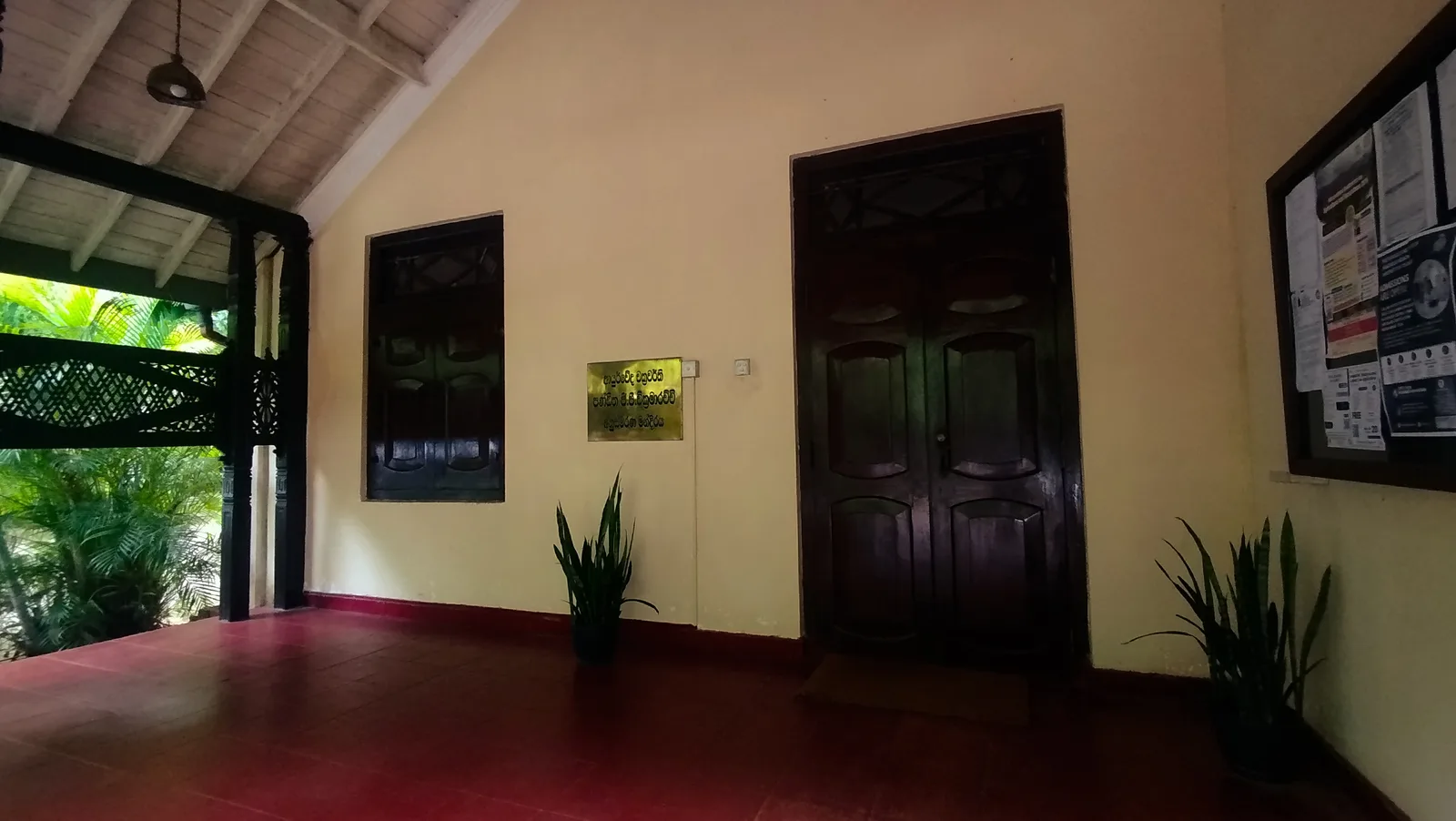
What gives the building its weight is not its scale but its position: it sits on the ground where the college was founded, at the institution that grew out of it, still in daily use. Students pass the plaque on their way to lectures. The campus also holds the Pandith G. P. Wickramarachchi Memorial Library, which carries his name a second time.
From Village College to National University
The institution's path from a fee-free rural school to a state university took ninety-two years.
Founded at Yakkala on 19 July as a college for Siddhayurveda and indigenous medicine.
Clinical treatment facilities and a medicine manufacturing operation established alongside the college.
Recognised by the state as an academic institute.
Curriculum reviewed and aligned with Gujarat Ayurved University.
Incorporated under the Ministry of Indigenous Medicine.
Affiliated to the University of Kelaniya as the Gampaha Wickramarachchi Ayurveda Institute.
The BAMS degree programme commences.
Postgraduate degree programmes commence.
Gampaha Wickramarachchi University of Indigenous Medicine comes into effect on 1 March as Sri Lanka's sixteenth national university, following an extraordinary gazette notification dated 28 October 2020. A ceremonial launch was held on 4 March 2021.
The University Today
Gampaha Wickramarachchi University of Indigenous Medicine still stands on Kandy Road at Yakkala, on the ground where the college was founded. It is Sri Lanka's first university dedicated to indigenous medical education.
Its Faculty of Indigenous Medicine states its purpose in unfussy terms: that a well-educated, well-trained and socially conscious physician will provide patient care that is medically and clinically sound, compassionate and safe. The faculty's stated approach is that indigenous medicine is best studied through an integration of traditional medical knowledge and modern scientific knowledge — a position that reads as a direct descendant of what Wickramarachchi went to Calcutta to learn.
Teaching is organised into departments covering Ayurveda basic principles, Cikitsa, Deshiya Cikitsa, Dravyaguna Vignana (materia medica and pharmacology), Kaumarabhrithya and Streeroga (paediatrics and gynaecology), Shalya-Shalakya (surgery and ophthalmology), Rogavignana (pathology), and languages — the last of these because the classical literature is in Sanskrit and Pali. A teaching hospital at Yakkala, listed among the Department of Ayurveda's institutions, provides the clinical training.
What an Ayurvedic doctor actually studies
The Bachelor of Ayurveda Medicine and Surgery (BAMS) is approved by Sri Lanka's University Grants Commission and runs for five years across pre-clinical, para-clinical and clinical stages, followed by a one-year internship conducted through the Department of Ayurveda. Completing that internship is a requirement for registration with the Sri Lanka Ayurvedic Medical Council. The degree is also recognised by India's Central Council of Indian Medicine for postgraduate study.
The curriculum runs from the classical theoretical framework and Sanskrit sources through anatomy, physiology and pathology, into materia medica, pharmaceutical preparation, diagnosis, clinical treatment, surgery and ophthalmology, community health and research methodology. It is worth being precise about what this does and does not mean. Ayurveda and biomedicine are distinct systems with different theoretical foundations, different diagnostic categories and different standards of evidence. An Ayurvedic degree is a serious, examined professional qualification in its own tradition; it is not a medical degree in the biomedical sense, and Sri Lankan law registers the two separately.
Plants, Food and the Sri Lankan Landscape
One reason this tradition took root and stayed here is botanical. Sri Lanka packs an extraordinary range of growing conditions into a small island: lowland rainforest, dry-zone scrub, wet-zone hills, montane cloud forest and a long coastline, with a high proportion of endemic plant species. Much of the plant material used in Sri Lankan preparations grows locally, and Dravyaguna — the study of medicinal substances — remains a full department in the university's curriculum.
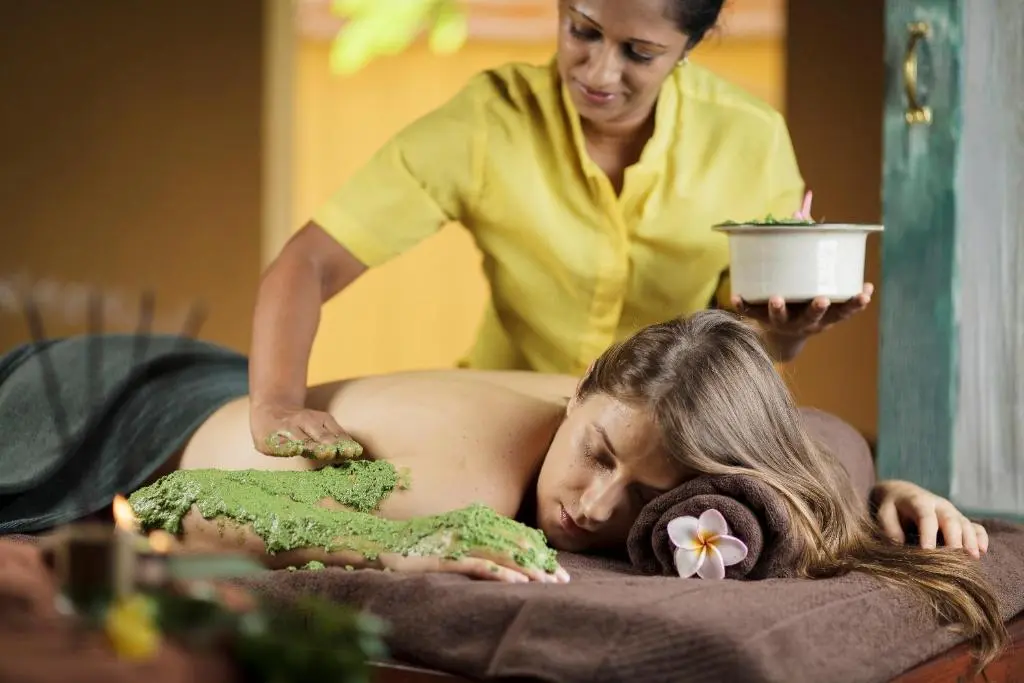
The tradition also extends well beyond the treatment room, and this is the part visitors most often miss. Ayurvedic thinking in Sri Lanka is bound up with daily routine, diet and season. It shows up in ordinary kitchens: gotu kola in a shredded salad, coriander tea for a cold, the tempering of curry leaves and pandan, kola kenda — a herbal rice porridge — at breakfast. Most Sri Lankan households carry some of this knowledge without labelling it Ayurveda at all.
Ayurveda Is More Than an Oil Massage
Here is the practical distinction most travellers need, and almost no brochure makes it clearly.
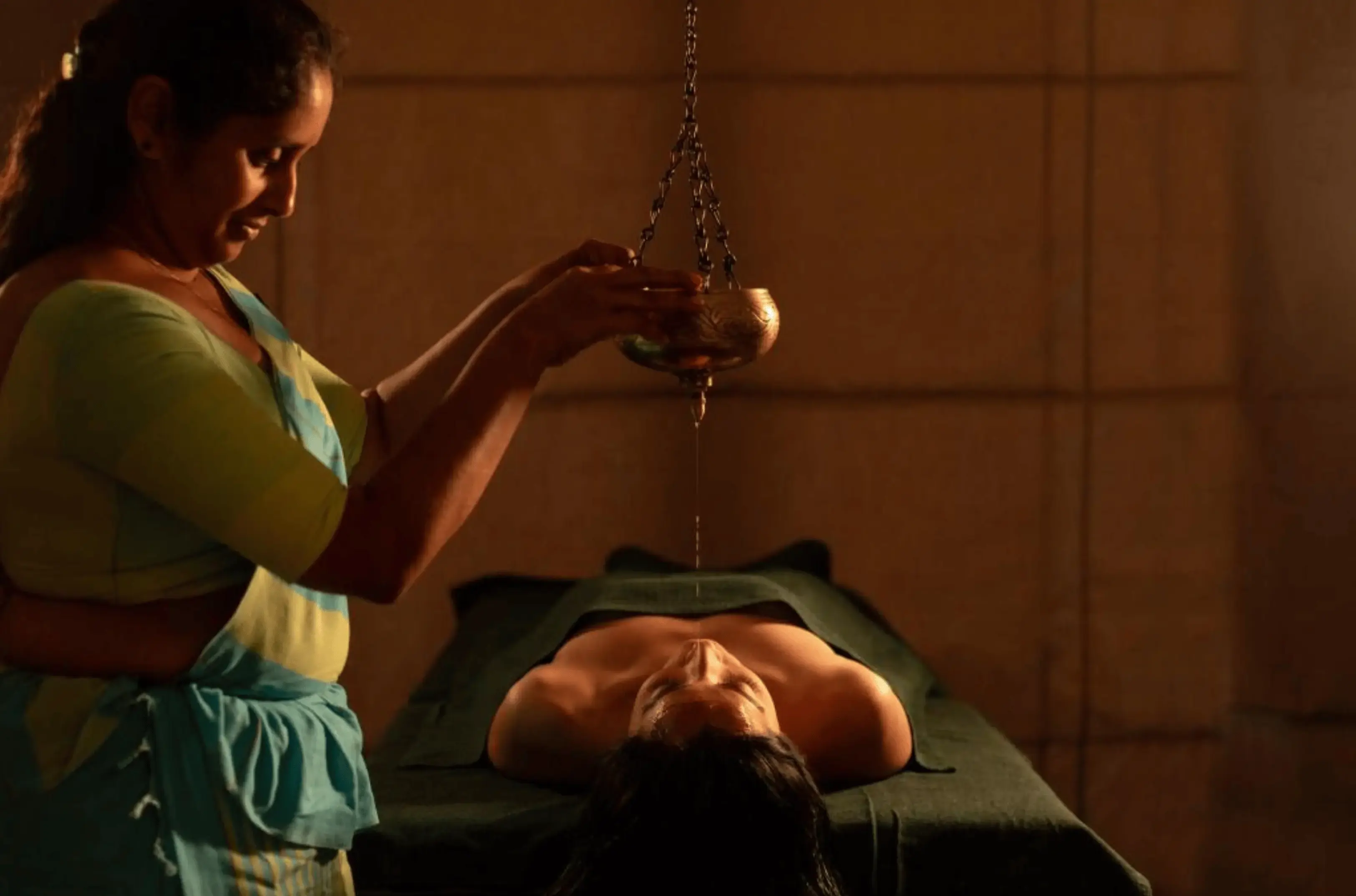
An Ayurveda-inspired wellness treatment is a spa service. You choose from a menu, you book a duration, you relax. The techniques may be entirely authentic and the therapist genuinely skilled. It is designed for relaxation and enjoyment, and there is nothing wrong with that — most visitors are looking for exactly this, and should book it without guilt.
An Ayurvedic medical consultation works differently. You do not choose your treatment from a list; a registered practitioner determines it. Depending on the practitioner and the case, it may involve an assessment of your constitution and current state through observation, pulse and history-taking, followed by a treatment plan that can combine internal herbal preparations, external therapies, and specific dietary and daily-routine recommendations. It generally assumes a course of treatment over days or weeks rather than a single session, and it involves follow-up.
If you want the second, ask for it explicitly, and ask whether the practitioner is registered with the Sri Lanka Ayurvedic Medical Council. Registered practitioners work in government Ayurvedic hospitals, in the teaching hospitals attached to the universities, and in private practice throughout the country.
Sri Lanka as a Wellness Destination
What makes Sri Lanka work for wellness travel is not any single element but how short the distances are between them. In one week you can move from the coast to the hill country to the dry-zone heritage sites without spending your days on a plane. A wellness journey here does not have to mean two weeks inside one resort compound.
Experiences worth building into an itinerary include:
- A consultation with a registered practitioner, rather than a treatment chosen from a menu
- A guided walk through a herbal or spice garden, where the plants are named and their uses explained
- A cooking session focused on everyday Sri Lankan food and the herbs used in it
- Meditation at a temple or forest hermitage, a living practice here rather than a tourist activity
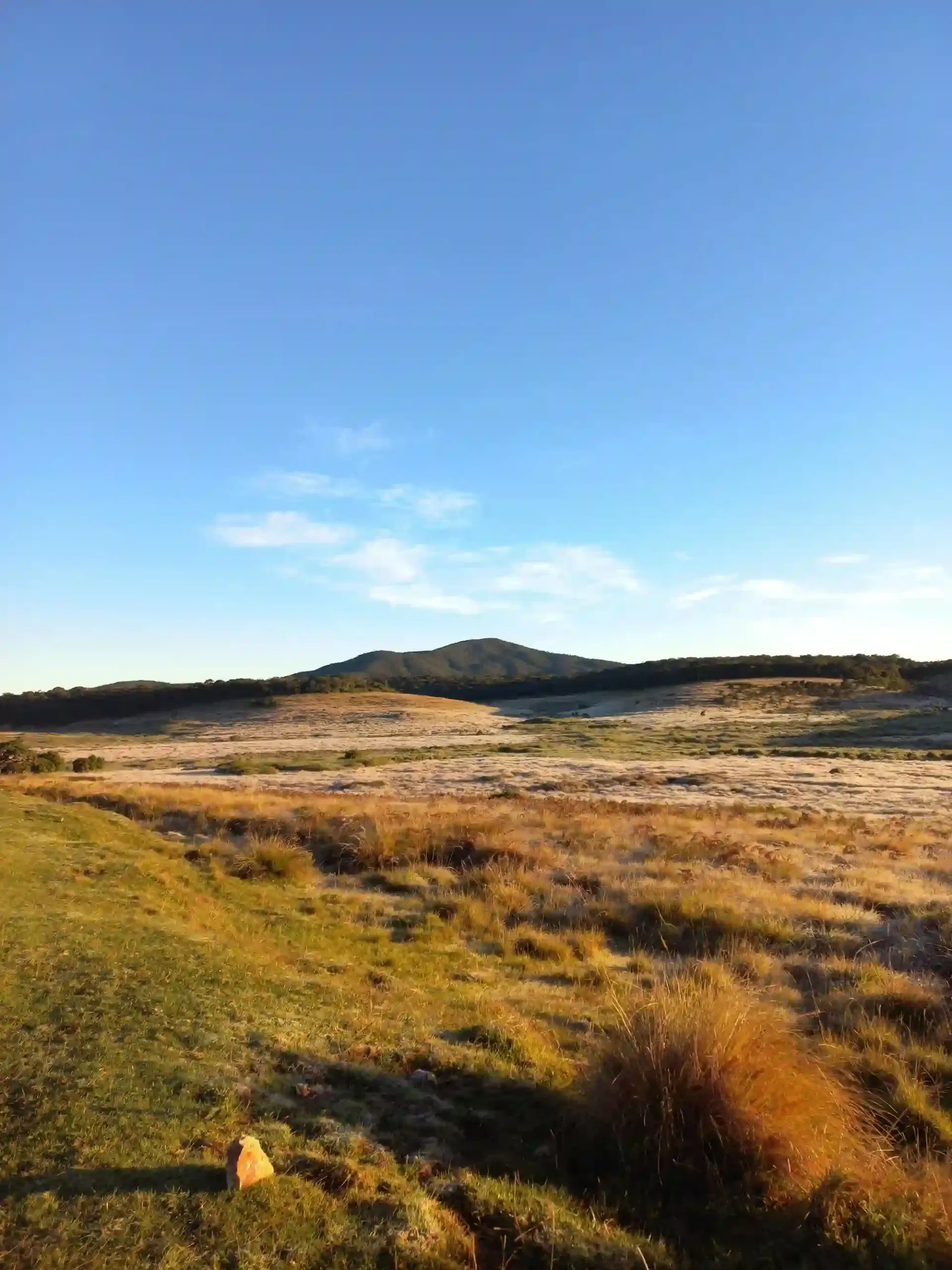
- Time in the hill country around Ella or Nuwara Eliya, where the climate itself changes the pace of a trip
- Cultural sites such as Anuradhapura, where the medical history described above is physically present in the ruins
Four properties, four different meanings of the word
The clearest way to see the distinction drawn above is to look at how differently established Sri Lankan properties use the same word. These four are not a ranking; they sit at different points on the spectrum, and the differences between them are exactly what a traveller needs to understand before booking.
Disclosure: Lanka Travel Gateway works in partnership with each of the four properties described below and can arrange stays at them. We have described them as they present themselves and as they differ from one another, not as an endorsement of one over another.
Heritance Ayurveda Maha Gedara — Beruwala
The most clinical of the four. Stays begin with a consultation with a senior physician, and treatments are prescribed from there rather than selected from a menu, with programmes typically structured over six to fourteen days. The building is a Geoffrey Bawa design that opened as the Neptune Hotel and was later renamed Maha Gedara, meaning ancestral home; it was refurbished in 2010 by Vinod Jayasinghe, who trained under Bawa. Operated by Aitken Spence.
Jetwing Ayurveda Pavilions — Ethukale, Negombo
A small dedicated Ayurveda retreat of twelve pavilions, where treatments — powder and herbal poultice massages, shirodhara — are given either in the privacy of your own pavilion or at the Ayurveda centre, with daily yoga in the yoga shala. It is the first hotel in Sri Lanka certified by Veggie Hotels, and the kitchen is vegetarian and vegan throughout.
Jetwing Lagoon — Negombo
An adults-only wellness hotel set between the lagoon and the ocean, in a Geoffrey Bawa building. Here Ayurvedic and aromatherapy treatments are offered à la carte alongside detox menus and bespoke wellness programmes — the wellness-hotel model rather than a dedicated Ayurveda centre. A good illustration of why the question "is this a treatment programme or a spa menu?" is worth asking.
Ulpotha Yoga & Ayurveda Retreat — Embogama, North Western Province
A different proposition altogether: a working village and organic farm at the foot of the Galgiriyawa hills, where guests stay in hand-built mud-and-adobe huts, paths are lit by lantern, and connectivity is minimal by design. Two-week yoga retreats with visiting international teachers run alongside unhurried Ayurveda treatments. It opens only for part of the year so the land can revert to the community when it is closed, and its stated commitments include organic farming, reforestation and the revival of old irrigation tanks.
Between a physician-led programme at Beruwala and a lantern-lit adobe hut in the Kurunegala hinterland lies most of what Sri Lanka means by wellness. All four are legitimate. They are simply not the same thing, and the word on the website will not tell you which you are getting — the consultation policy, the length of the programme and the qualifications of the practitioner will.
Why This History Matters to a Traveller
You do not need to know any of this to enjoy a treatment. But knowing it changes what the hour means.
The therapist's technique was taught to them by someone. The oil follows a formula that was written down, tested, argued about and revised. The plant in it has a name in Sanskrit, a name in Sinhala, and a chapter in a textbook that a student at Yakkala sat an examination on. The framework organising all of it survived colonial neglect because physicians kept teaching through it, and because in 1929 one of them put up his own land and his own money to make sure it would still be taught after he was gone.
That is the difference between a service and an encounter with a living tradition. The tradition does not need the traveller to validate it — it was here long before wellness tourism and will outlast it. But the traveller who understands what they are participating in gets considerably more out of the experience.
Travelling Responsibly
A few straightforward guidelines will improve your experience and reduce the risk of a poor one:
- Ask about qualifications. Reputable establishments will tell you plainly whether a practitioner is registered and where they trained. Hesitation is informative.
- Know which you are booking. A relaxation treatment and a medical consultation are different products at different prices. Both are legitimate; conflating them is not.
- Disclose your health information. Tell the practitioner about pregnancy, existing conditions, and any medication you take. Herbal preparations can interact with prescription drugs.
- Be sceptical of cure claims. Any establishment guaranteeing to cure a serious illness in a fortnight is selling something. Serious practitioners do not talk that way.
- Do not substitute this for necessary medical care. Continue your prescribed treatment and consult your own doctor before changing anything. Wellness travel complements medical care; it does not replace it.
- Respect the setting. At temples and religious sites, dress modestly and follow local practice.
A Tradition Still Being Taught
The line running through this story is a single unbroken one: village physicians teaching their children; a young man from Nadungamuwa travelling to Calcutta in 1917 to learn how medicine could be taught systematically; a fee-free college opened on his own land in 1929; state recognition, a teaching hospital, a degree programme; and, in 2021, a national university carrying his name.
Students walk into lecture halls at Yakkala every year on ground that one physician set aside almost a century ago because he was unwilling to watch the knowledge disappear. That is not a marketing story. It is simply what happened, and it is still happening.
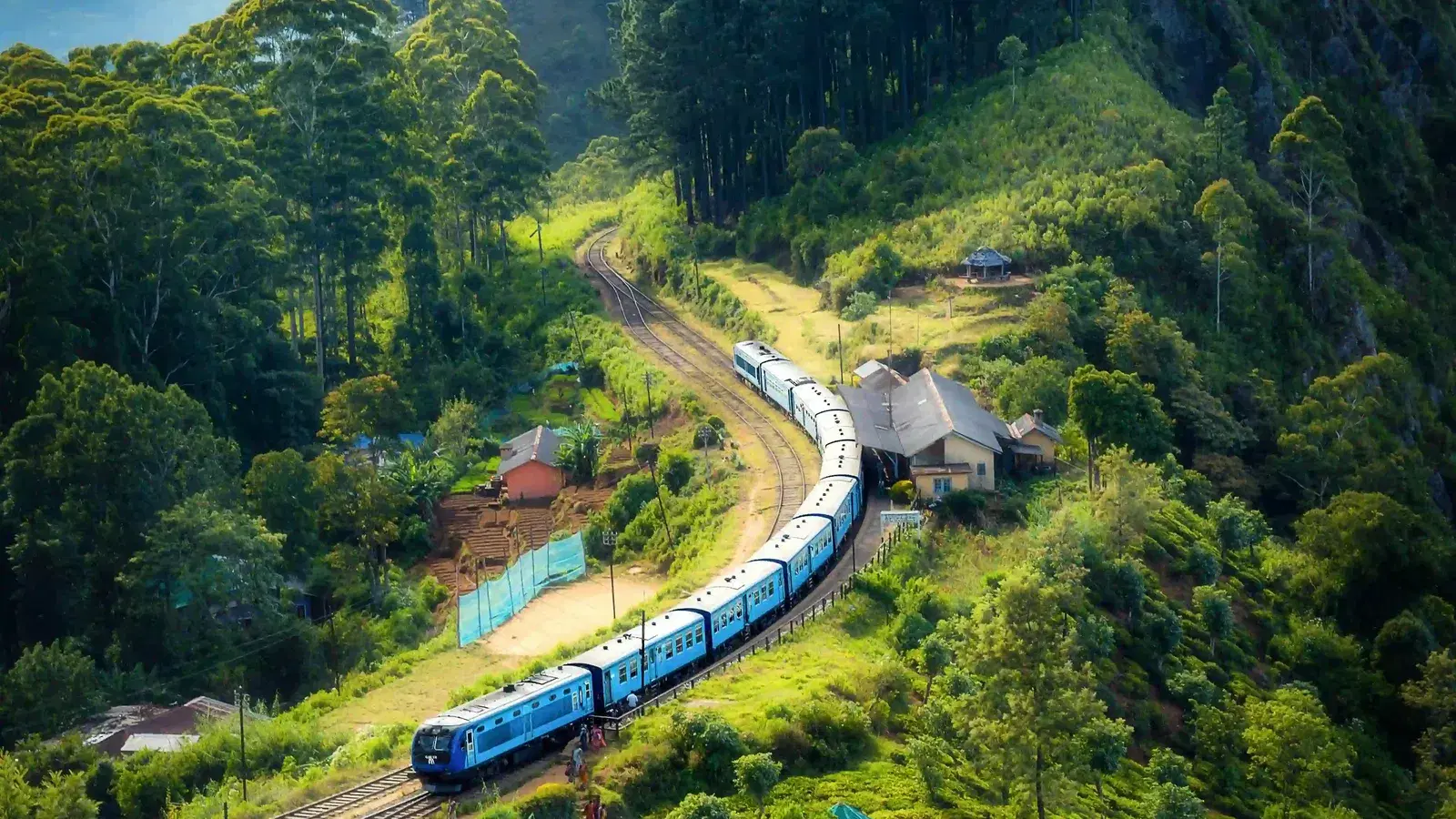
Sri Lanka is easy to experience through its beaches, its temples, its wildlife and its train journeys through the hills. It can also be experienced through one of its oldest living traditions of healing and wellbeing — one that was never only about the oil.
Frequently Asked Questions
Is Ayurveda in Sri Lanka the same as Ayurveda in India?
They share classical texts and core theory, but Sri Lankan practice has absorbed a great deal from Deshiya Chikitsa, the island's own indigenous tradition, and uses locally available plants. Sri Lanka also regulates and teaches it under its own national framework.
How long should an Ayurvedic treatment programme be?
A single treatment is a spa session. A therapeutic programme is typically prescribed over a longer period, and the duration is determined by the practitioner after assessment rather than chosen from a menu in advance.
How do I check whether a practitioner is qualified?
Ask whether they hold a BAMS degree or equivalent and whether they are registered with the Sri Lanka Ayurvedic Medical Council, which registers practitioners under the Ayurveda Act No. 31 of 1961. Established clinics answer this question readily.
Can I visit Gampaha Wickramarachchi University?
It is a working university at Yakkala, roughly an hour from Colombo depending on traffic, not a visitor attraction. Any visit would need to be arranged in advance with the university. Its teaching hospital is listed among the Department of Ayurveda's institutions.
When is the best time for a wellness trip to Sri Lanka?
The island has two monsoons, so somewhere is always in season. The west and south coasts are driest from roughly December to April, the east coast from around April to September. The hill country is comfortable year-round and cool at night.
Sources and Further Reading
- Gampaha Wickramarachchi University of Indigenous Medicine — Official history and Faculty of Indigenous Medicine
- Department of Ayurveda, Sri Lanka — ayurveda.gov.lk
- Sri Lanka Ayurvedic Medical Council — ayurvedicmedicoun.gov.lk
- Ayurveda Act No. 31 of 1961 — full text, CommonLII
- Ministry of Health, Indigenous Medicine Section — mim.gov.lk
- Ancient Mihintale Hospital Complex — archaeological record of the ninth-century monastic hospital
- The Mahavamsa — for the earliest literary references to organised healthcare in Sri Lanka
- Memorial inscriptions at the Yakkala campus — the statue plinth and the Memorial Building nameplate, photographed for this article and used here as primary sources for the founder's titles, dates and the original name of the college
Photography Credits
Photographs of the Wickramarachchi memorial statue, the inscribed plinth and the Memorial Building at the Yakkala campus were taken by Lanka Travel Gateway.
Ayurveda treatment, yoga and retreat photography is reproduced with credit to the properties whose work it documents:
- Heritance Ayurveda Maha Gedara, Beruwala
- Jetwing Ayurveda Pavilions, Negombo
- Jetwing Lagoon, Negombo
- Ulpotha Yoga & Ayurveda Retreat, Embogama
Image rights remain with the respective properties and their photographers. If you are a rights holder and would like an image credited differently or removed, please contact us and we will act promptly.
This article is provided for general information and cultural interest. It is not medical advice and should not be used to diagnose or treat any condition. Consult a qualified healthcare professional about your own health, and inform any practitioner of existing conditions and medications before beginning treatment.
Photo Gallery
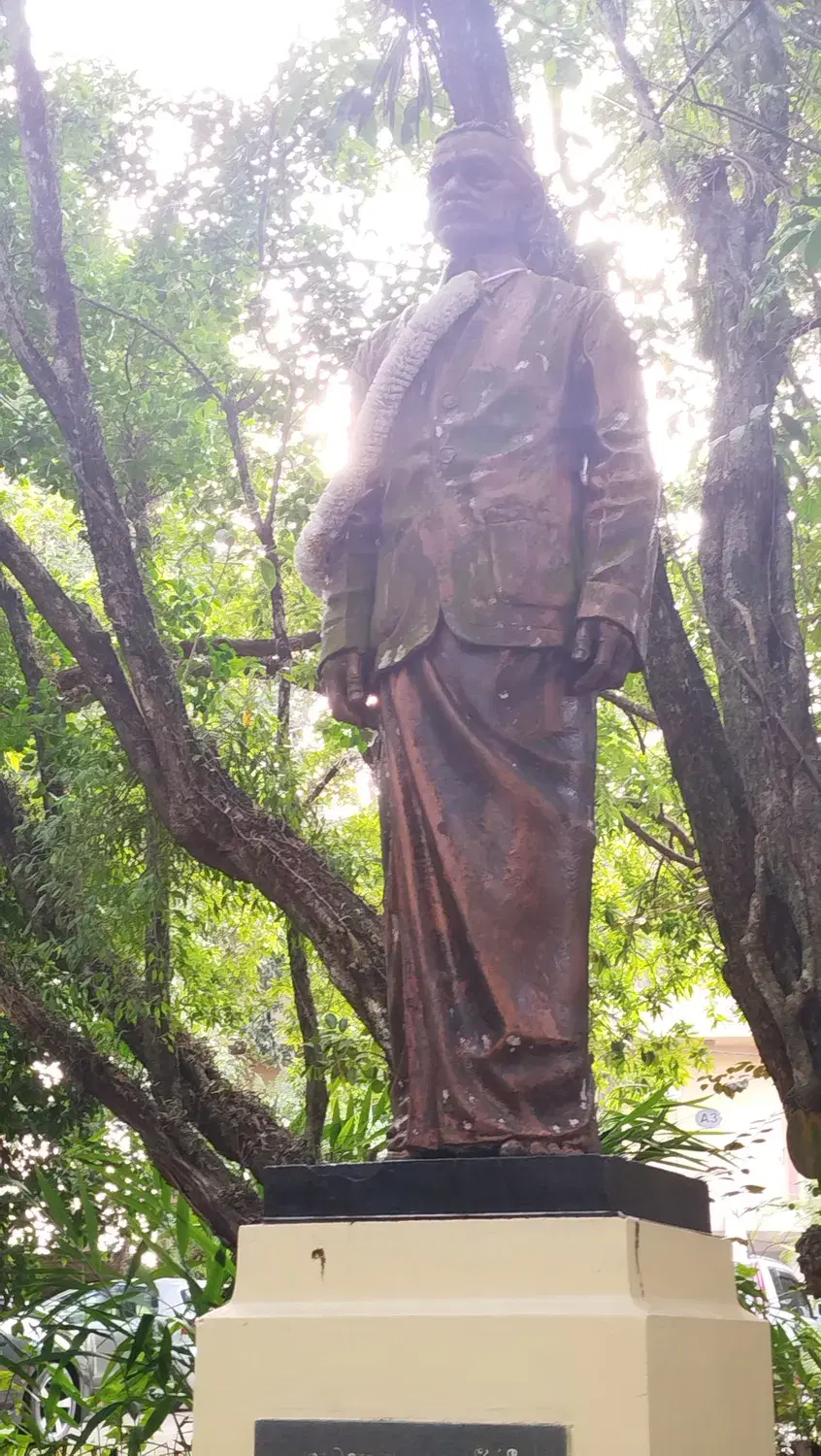
Memorial Statue of Pandith G. P. Wickramarachchi
The bronze memorial statue of Ayurveda Chakravarthi Pandith G. P. Wickramarachchi at the Yakkala campus, honouring the founder of the college that became Gampaha Wickramarachchi University of Indigenous Medicine.
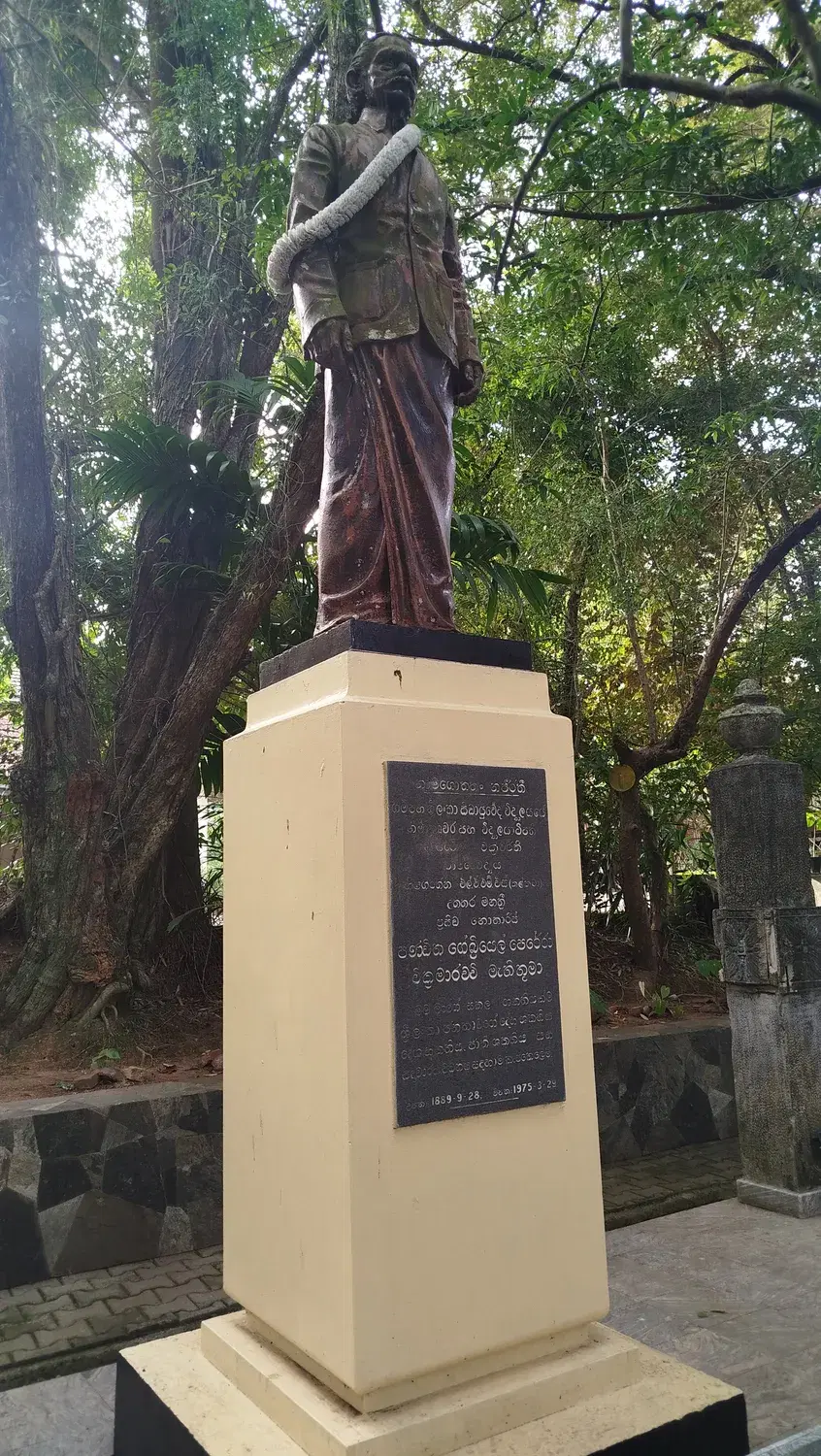
The Inscribed Plinth
The Sinhala inscription on the statue plinth records Wickramarachchi as founder and principal of the Gampaha Sri Lanka Siddhayurveda Vidyalaya, Ayurveda Chakravarthi, Bhishagratna L.A.M.S. (1920), senator and public notary, with the dates 1889-9-28 and 1975-3-29.
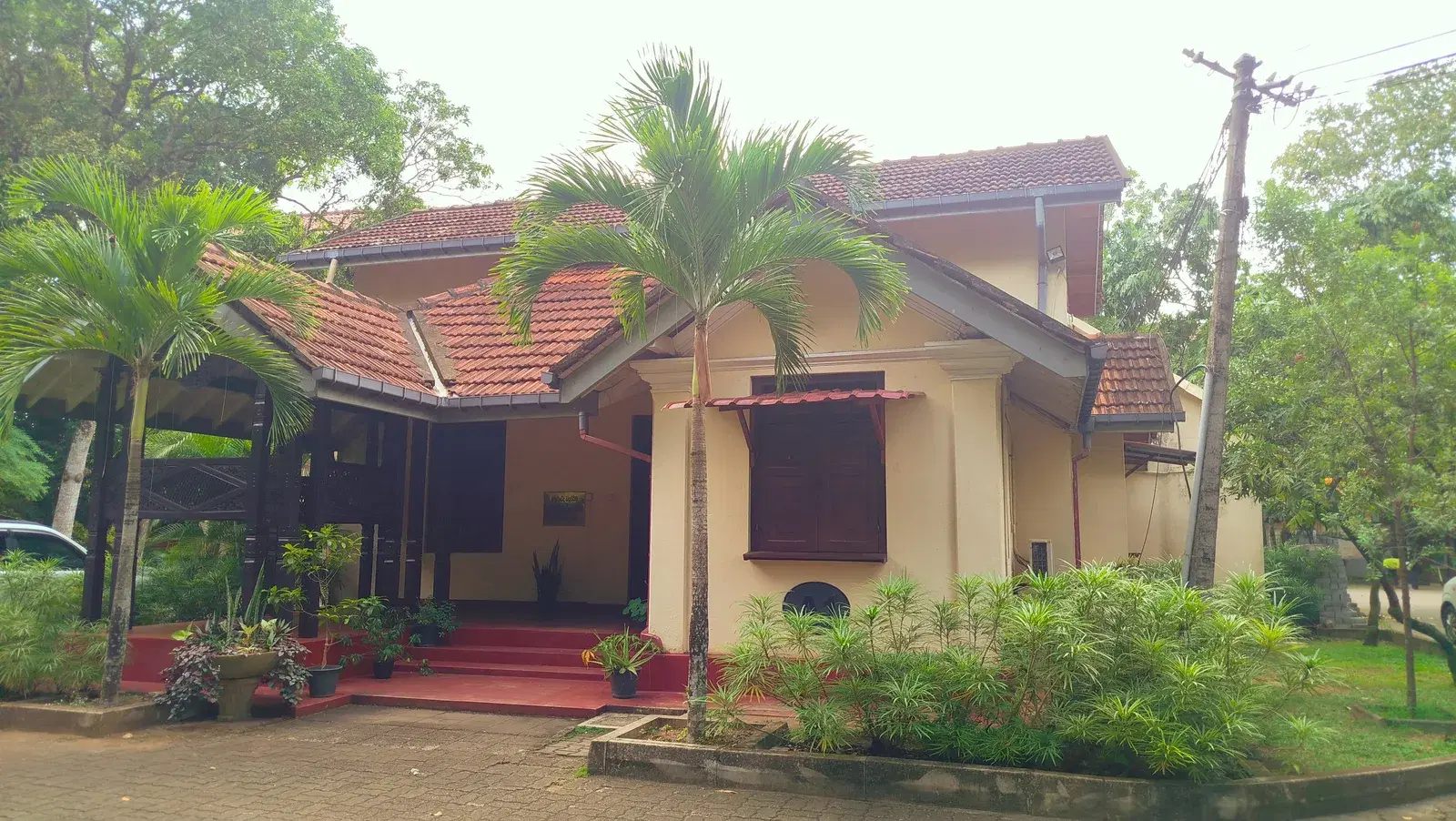
The Wickramarachchi Memorial Building
The Ayurveda Chakravarthi Pandith G. P. Wickramarachchi Memorial Building (Anusmarana Mandiraya) at Yakkala, with its tiled roofs and deep carved timber verandah.
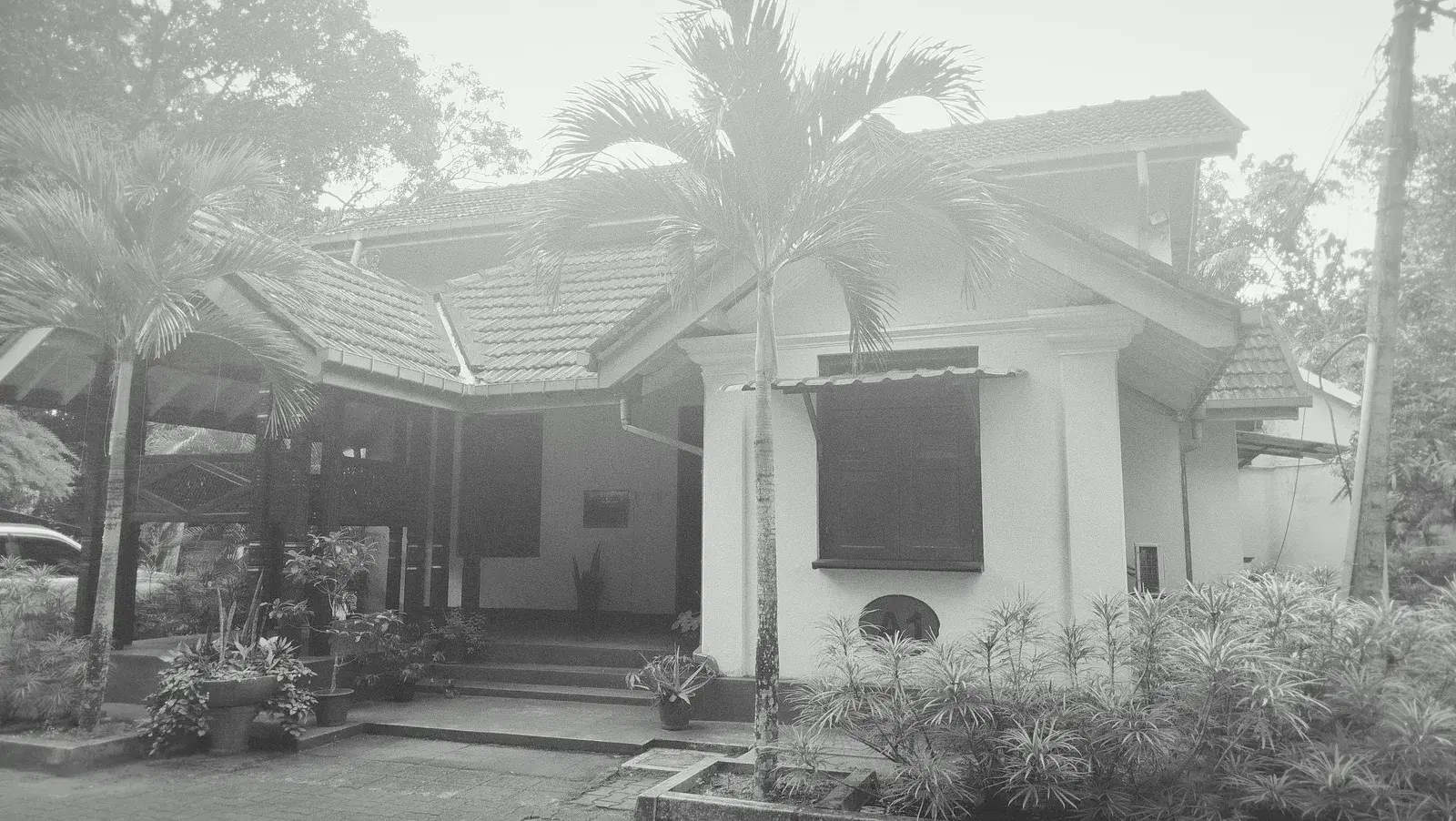
The Memorial Building in Monochrome
The same memorial building rendered in black and white. The monochrome treatment is a photographic choice, not a historical photograph.
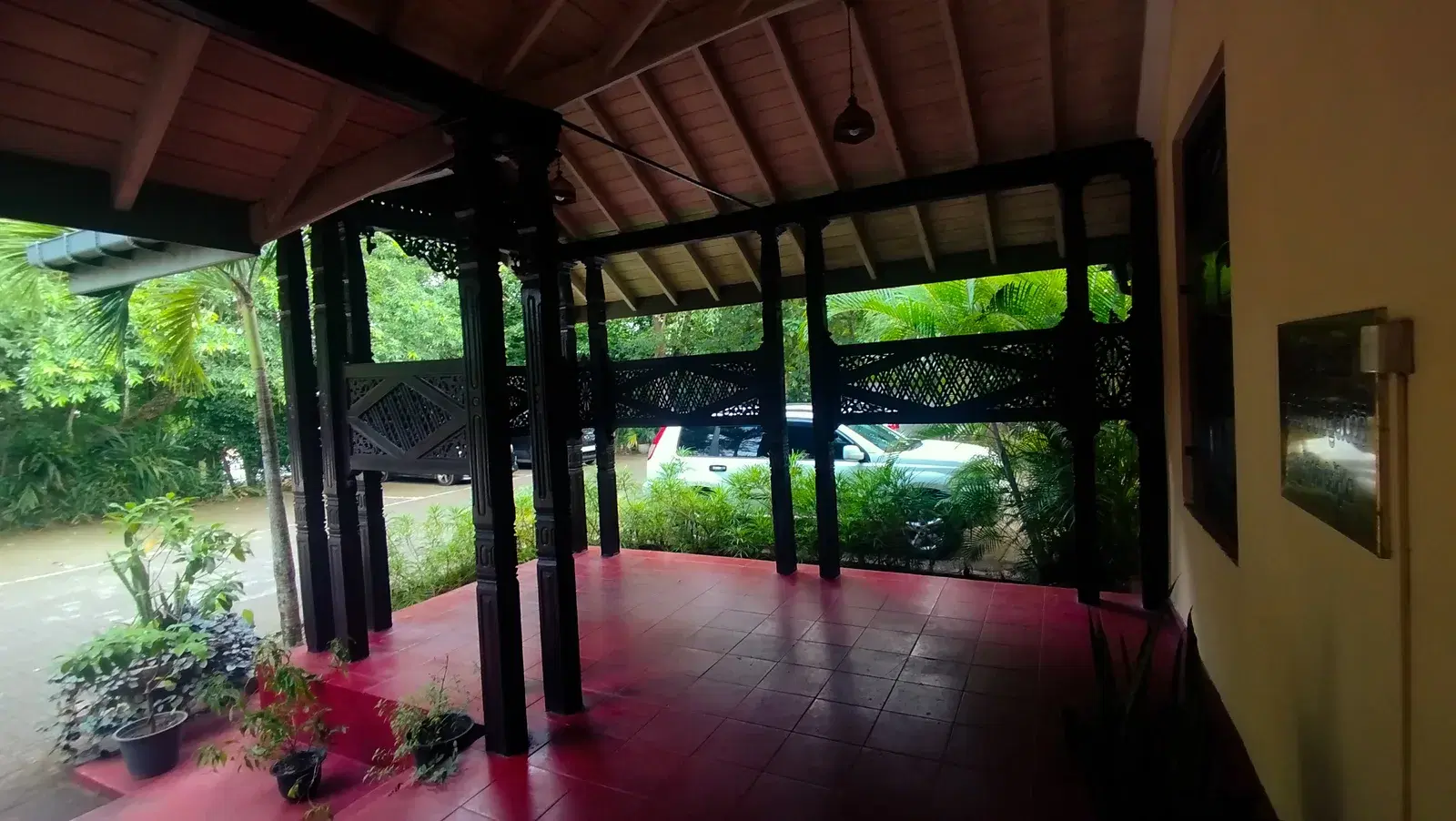
Verandah of the Memorial Building
The verandah of the memorial building, framed by carved black timber columns and pierced fretwork panels, opening onto the campus grounds.
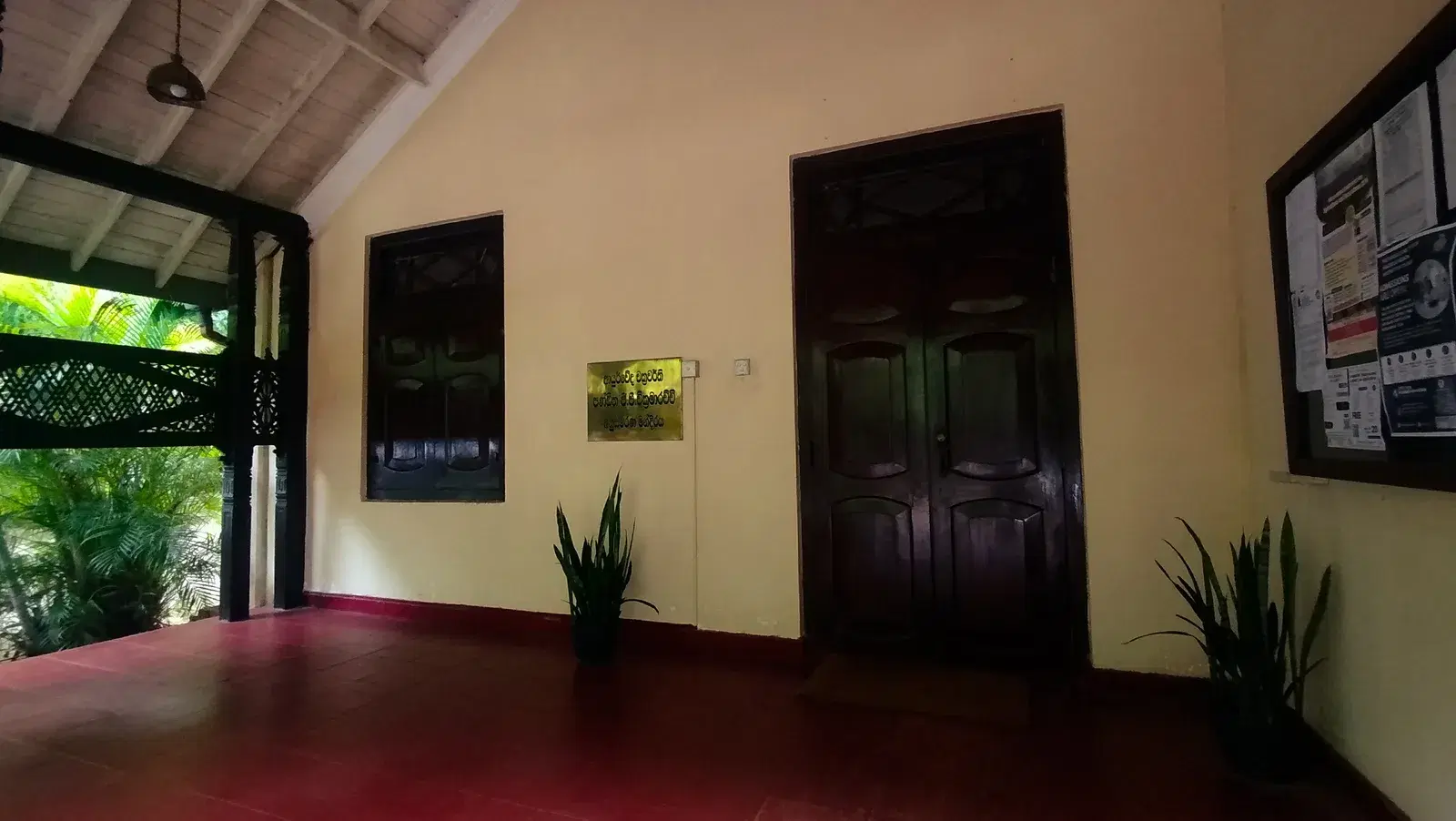
The Memorial Building Nameplate
The brass nameplate inside the verandah, naming the building in Sinhala as the Ayurveda Chakravarthi Pandith G. P. Wickramarachchi Anusmarana Mandiraya, or Memorial Building.
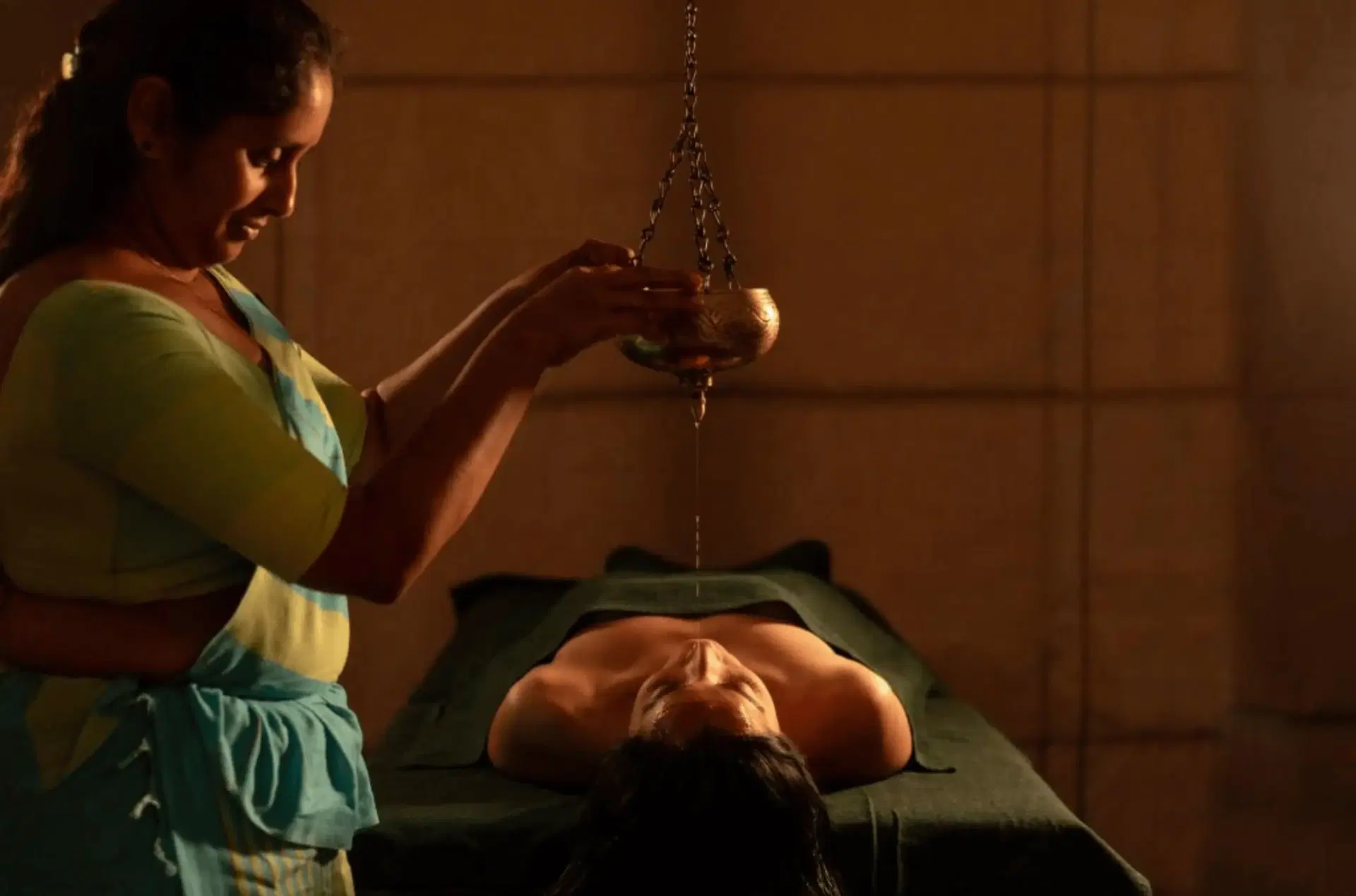
Shirodhara Treatment
A steady stream of warm medicated oil poured onto the forehead from a suspended vessel — the treatment known as shirodhara, among the most recognisable in the Sri Lankan Ayurvedic repertoire.
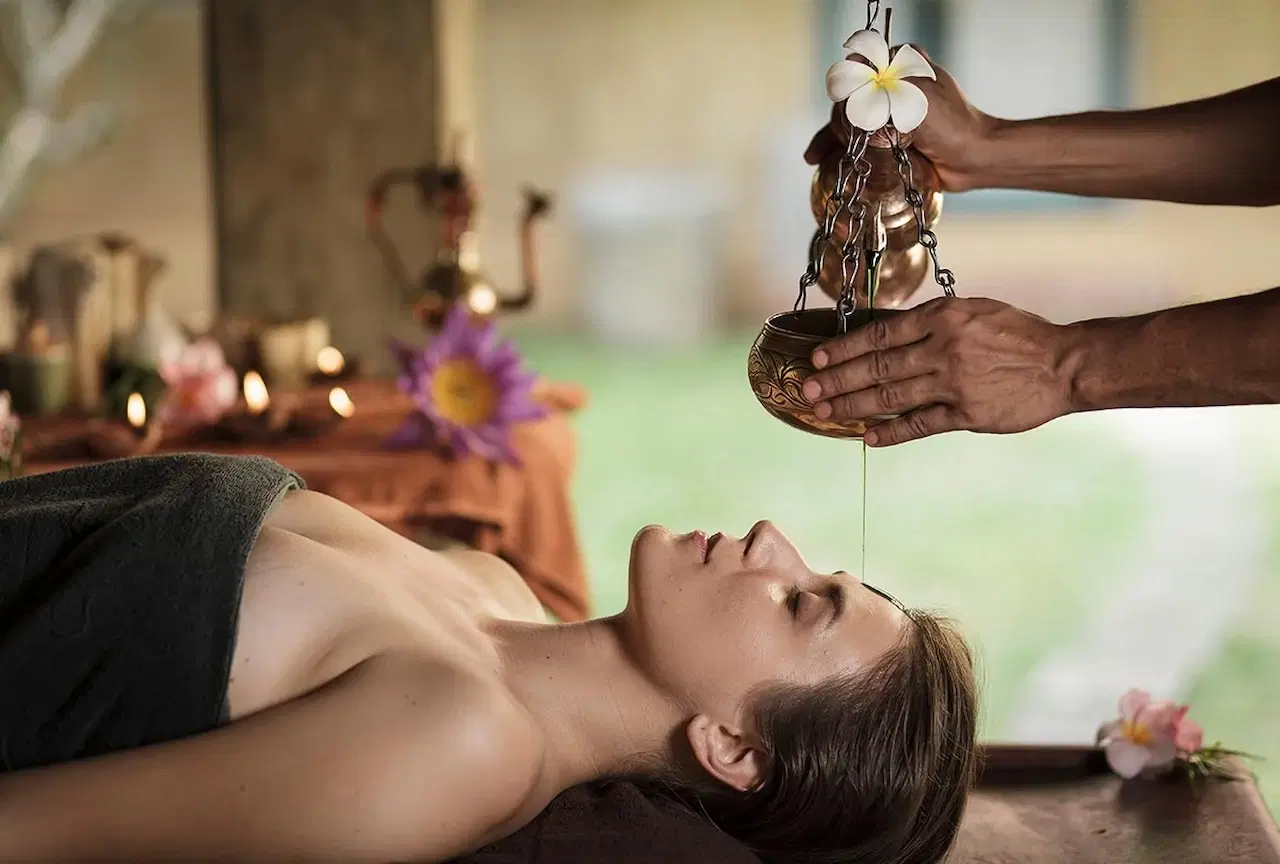
Warm Oil Therapy in an Open-Air Setting
An Ayurvedic oil treatment carried out in an open-sided pavilion, a common arrangement at Sri Lankan wellness centres where treatment rooms open onto gardens.
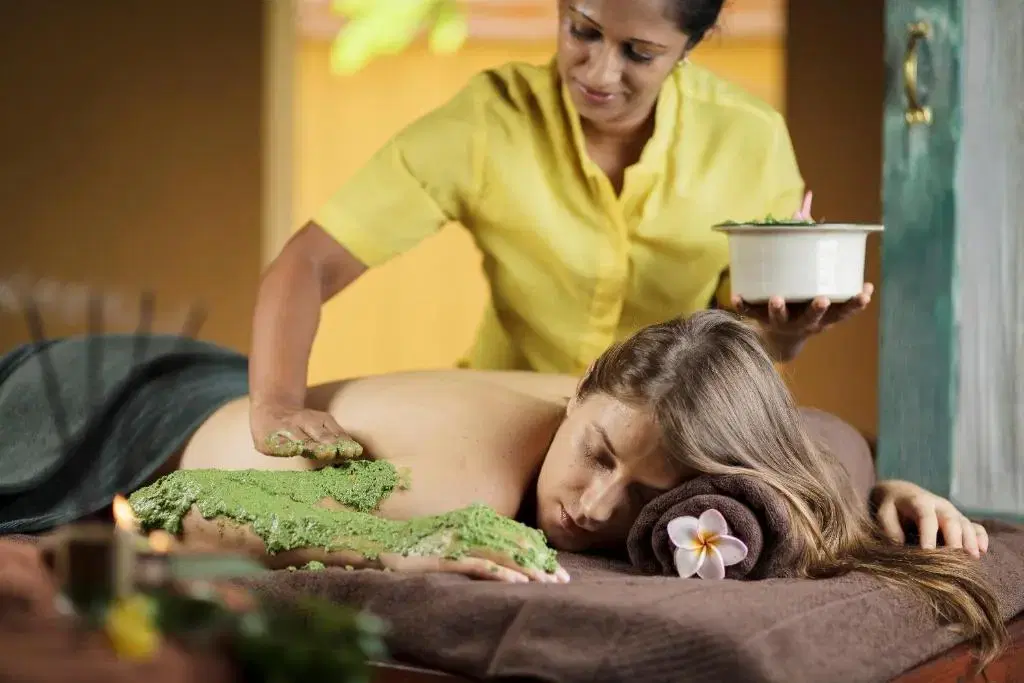
Herbal Paste Application
A therapist applying a fresh herbal paste during a body treatment. Preparations of this kind are made from plant material and used externally as part of traditional wellness therapies.
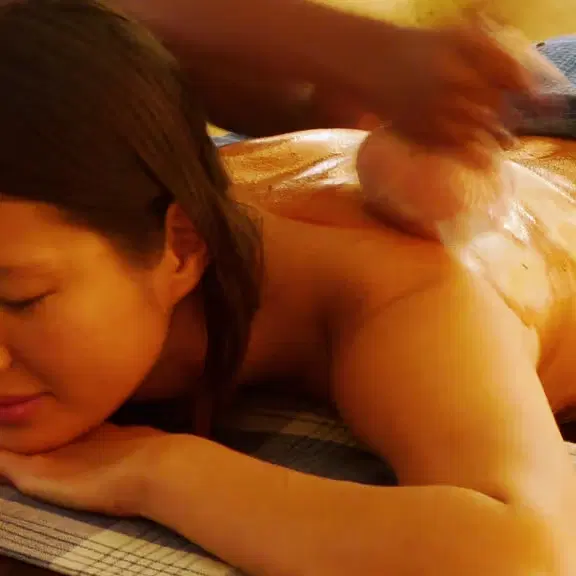
Herbal Bolus Treatment
A warmed cloth-bound bundle of herbs worked across the body — a preparation technique taught as part of the practical training in Sri Lankan indigenous medicine.
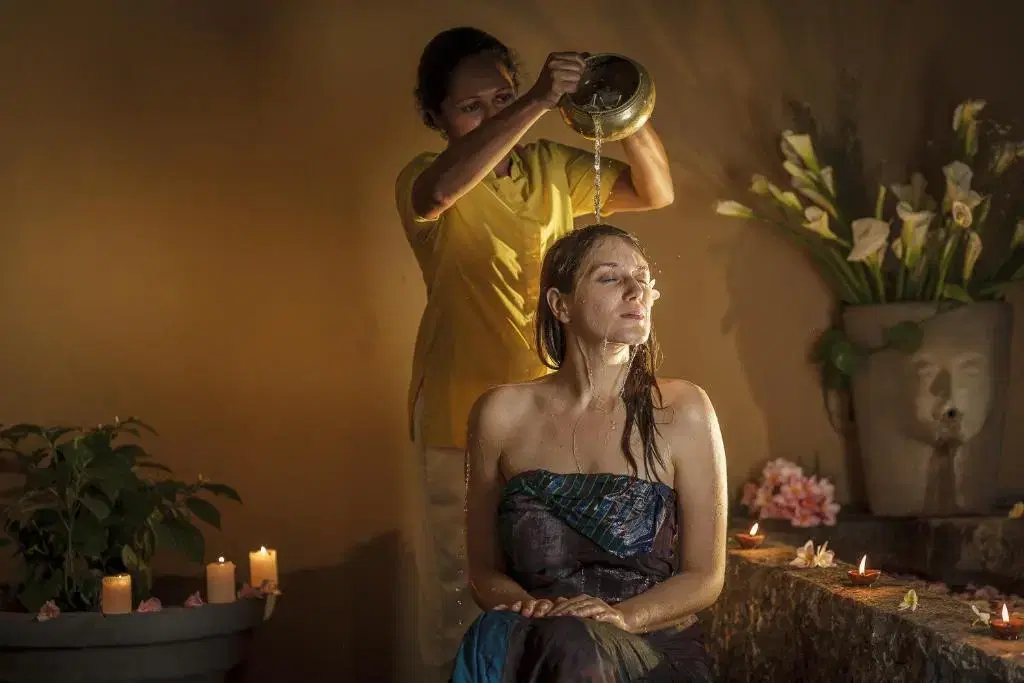
Traditional Herbal Bath
A herbal water treatment poured over the head and shoulders, typically concluding a longer sequence of therapies.
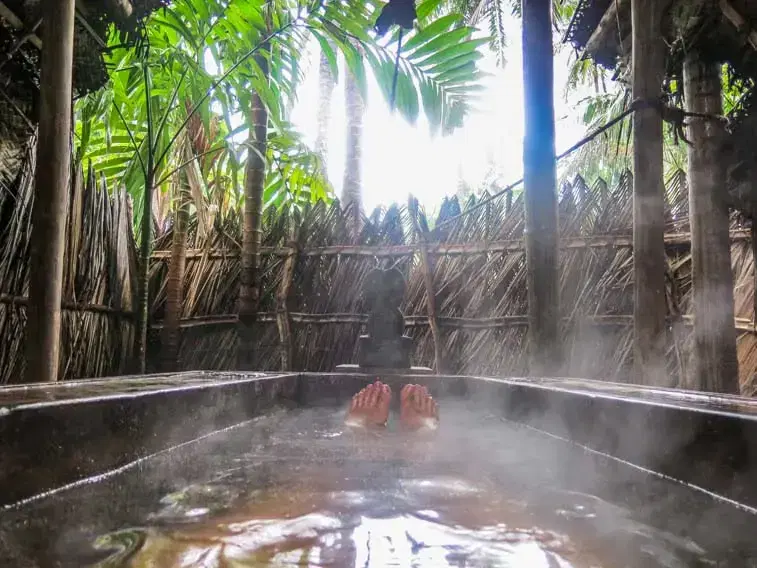
Open-Air Herbal Soaking Bath
A steaming outdoor soaking bath screened by palm thatch, set within the garden of a Sri Lankan wellness retreat.
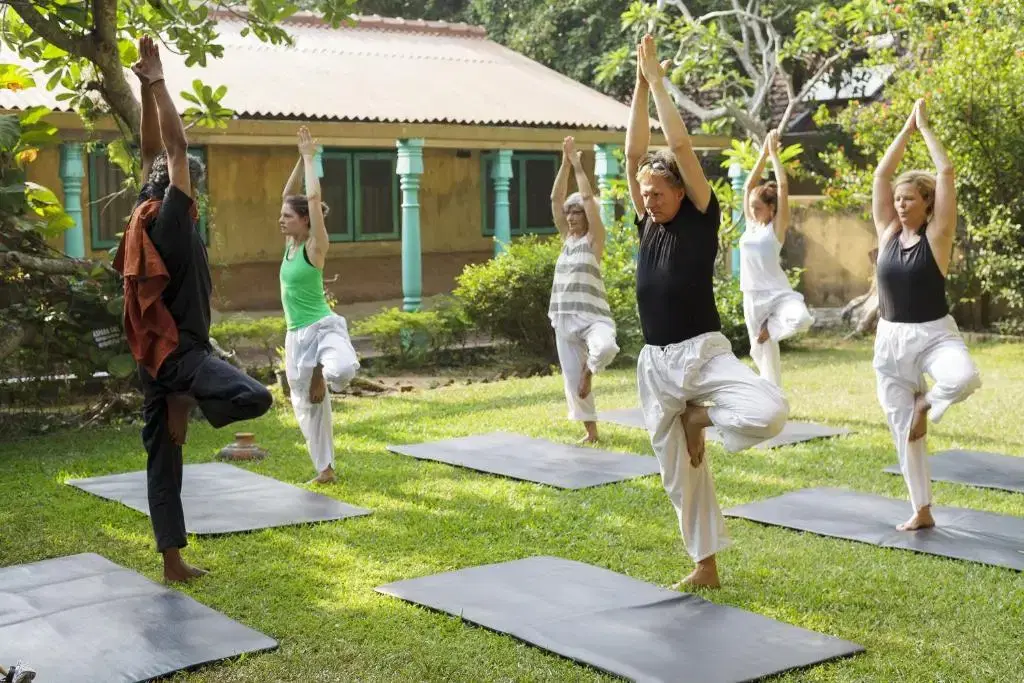
Morning Yoga in the Garden
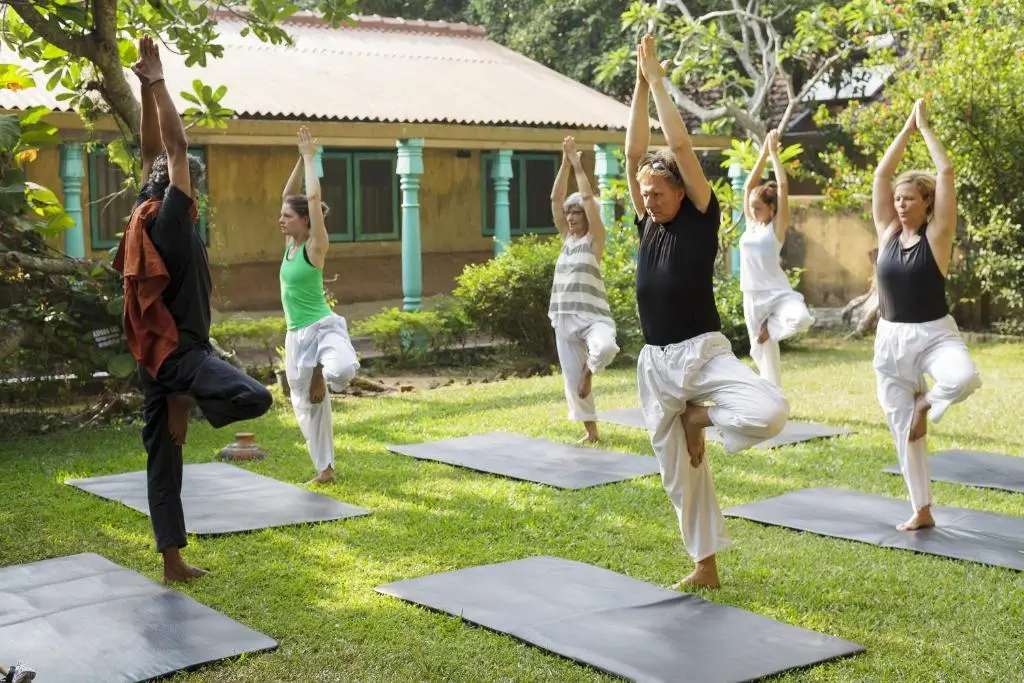
An outdoor yoga session held in the grounds of a Sri Lankan wellness property. Yoga is a distinct tradition from Ayurveda, though the two are frequently offered together.
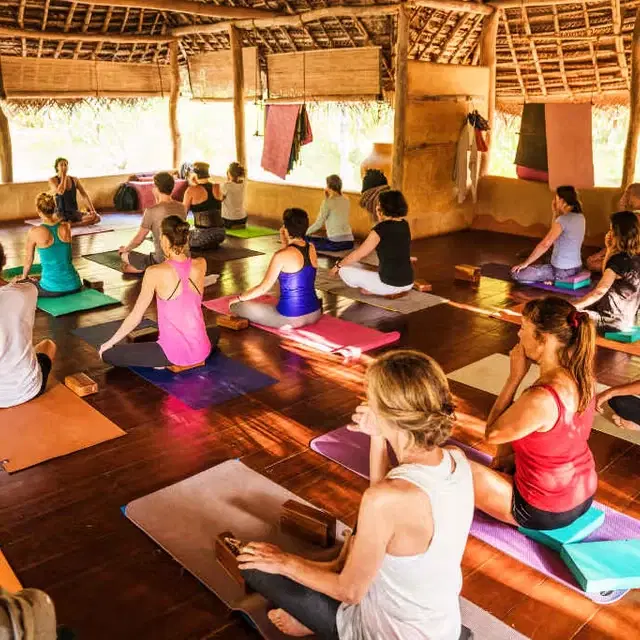
Yoga Hall Under Thatch
A group practice session in an open thatched hall, a building style used widely at Sri Lankan retreats for its natural ventilation.
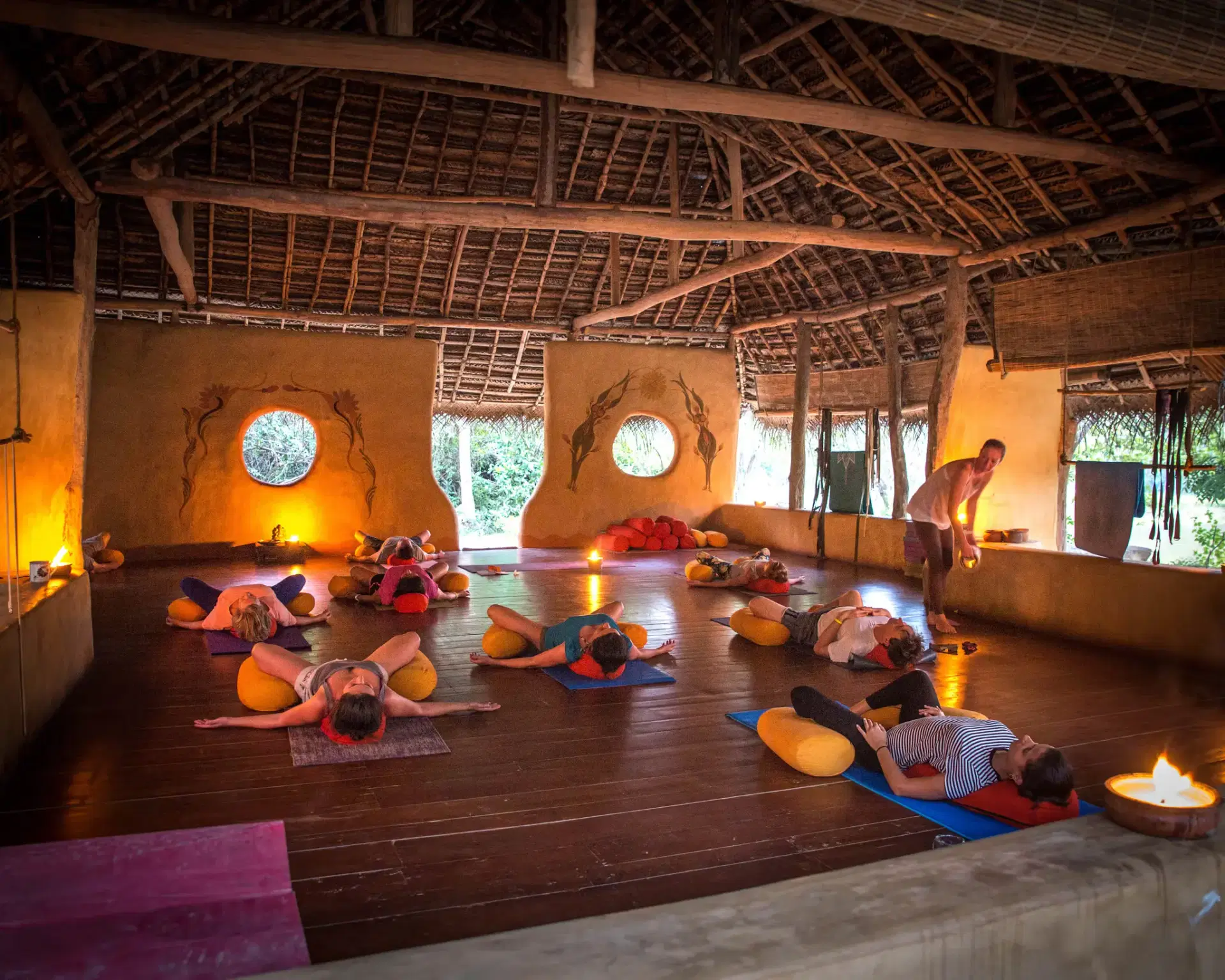
Guided Relaxation Session
A guided relaxation and breathing session at dusk in an open pavilion, typically scheduled at the close of the day.
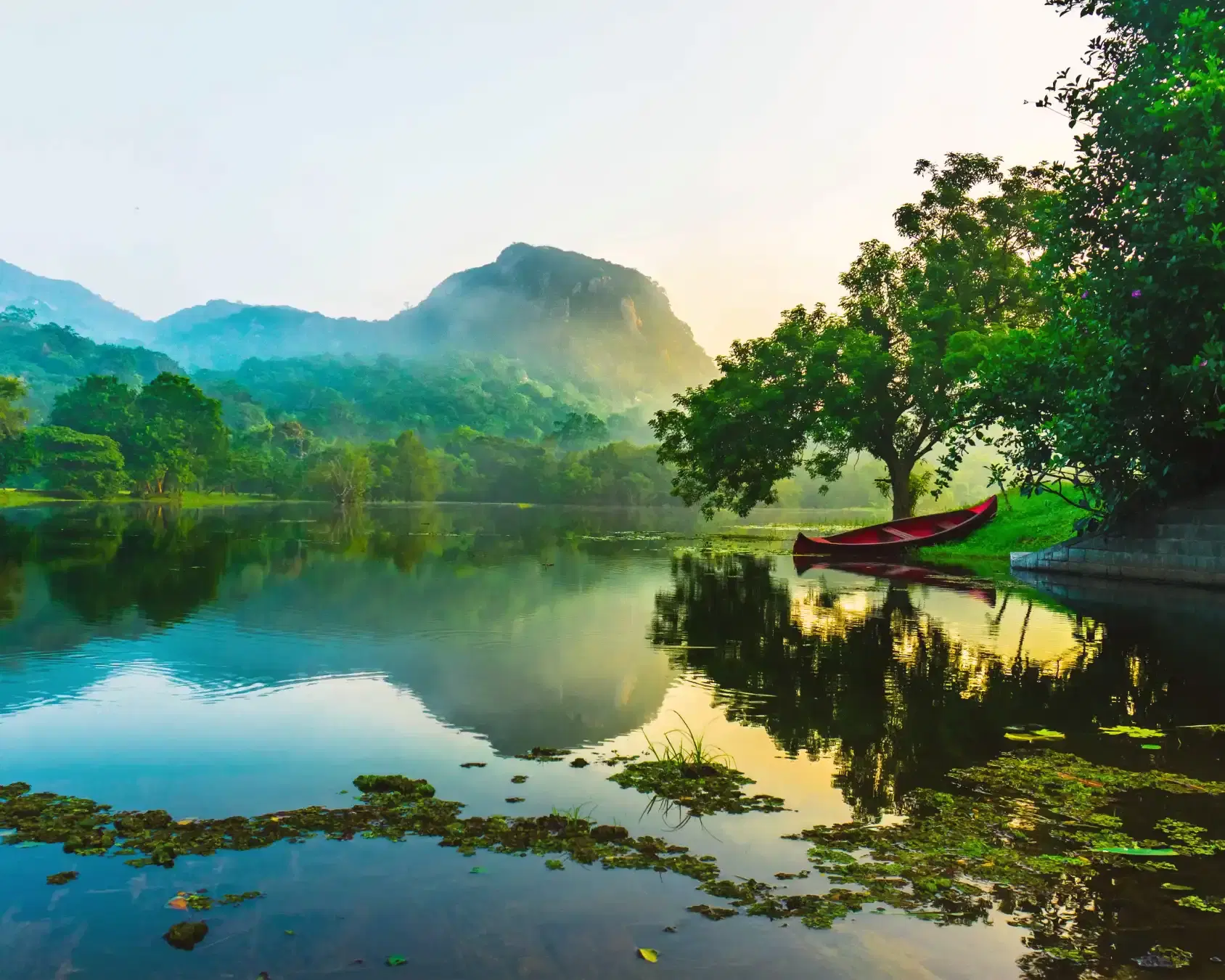
Sri Lankan Landscape and Medicinal Plants
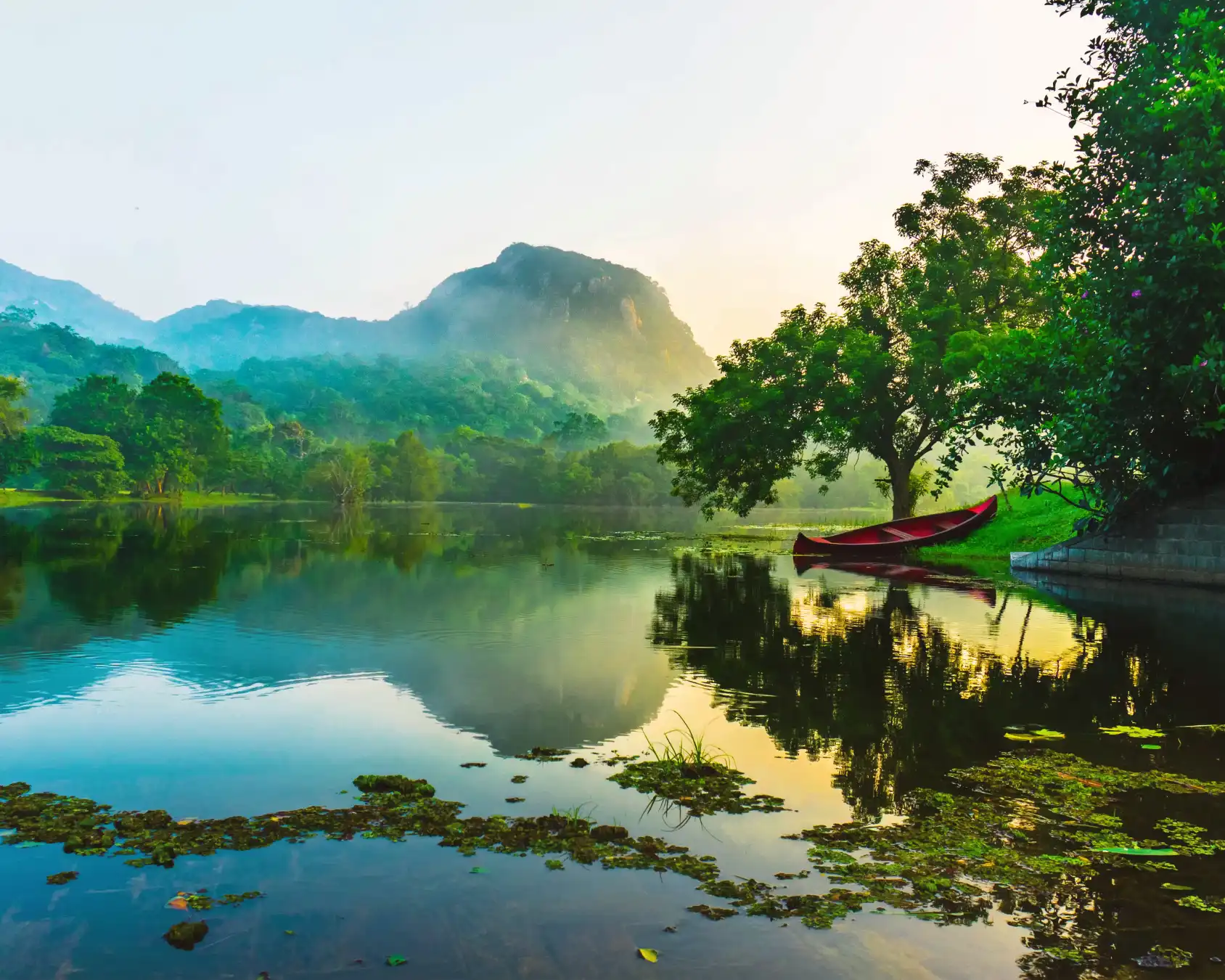
Forested hills and still water in rural Sri Lanka. The island's range of growing conditions supports the wide variety of plants used in traditional preparations.
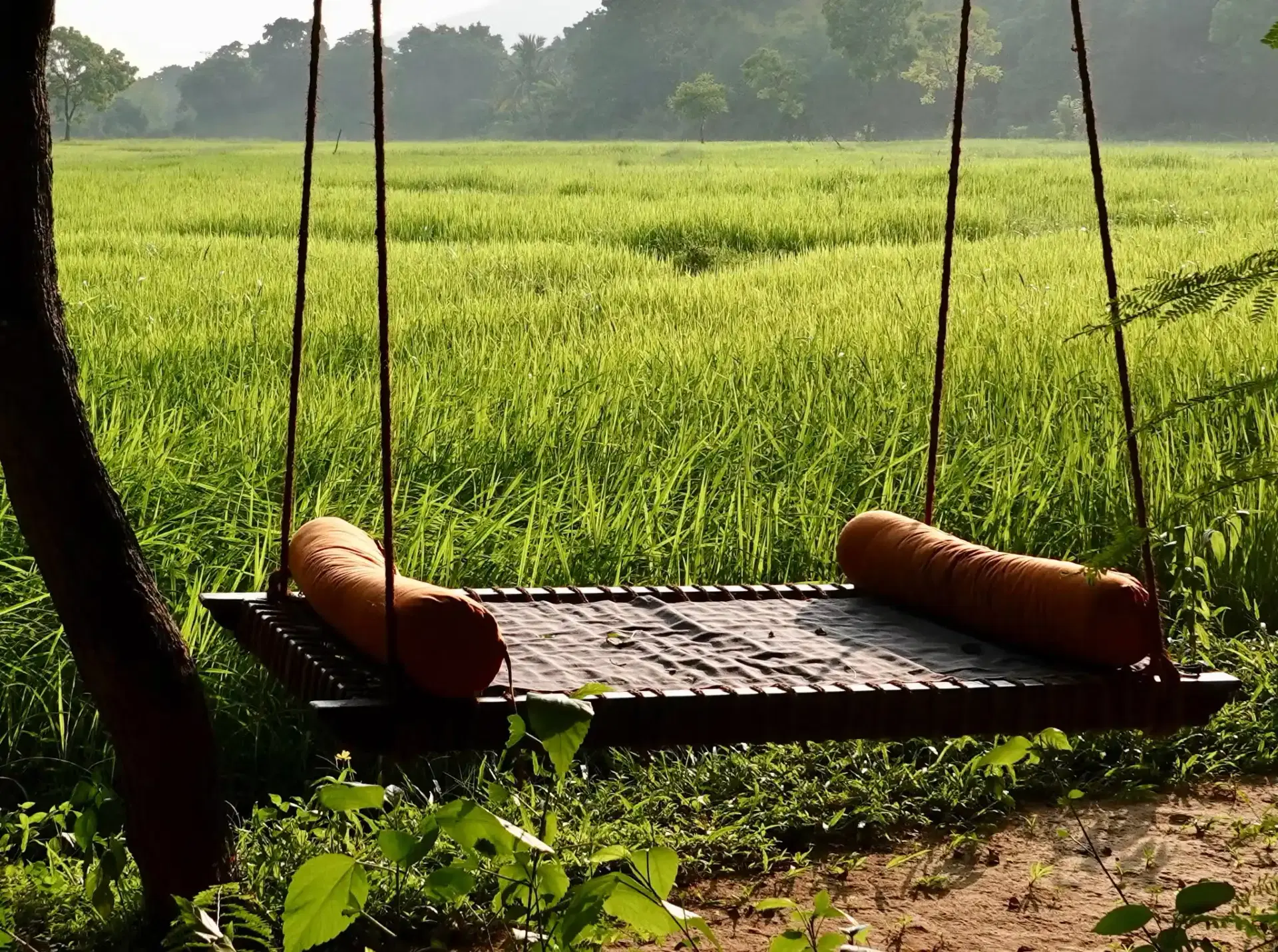
Rest Beside the Paddy Fields
A traditional hanging daybed overlooking paddy fields — the unhurried rhythm that shapes wellness travel in rural Sri Lanka.
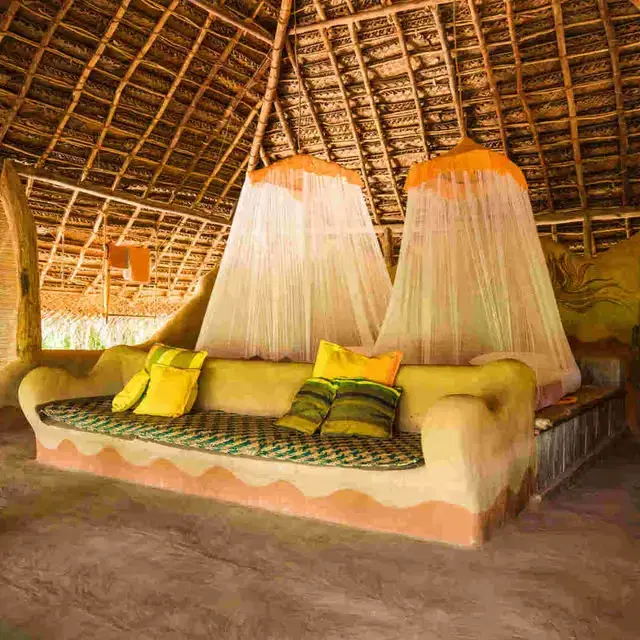
Guest Quarters at a Wellness Retreat
Sleeping quarters built with earthen walls and a thatched roof, a construction style favoured by retreats working with local materials.